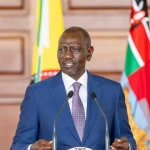

The Government of Kenya has officially locked in a monumental KSh 22.1 billion (25 billion Yen) financial agreement with Japan designed to dramatically scale up local vehicle manufacturing, jumpstart domestic electric vehicle (EV) ecosystems, and lower production costs for local assemblers. The deal, structured as a Samurai Bond framework, was formally signed at State House, Nairobi, by National Treasury Cabinet Secretary John Mbadi and Atsuo Kuroda, the Chairman and CEO of Japan’s Nippon Export and Investment Insurance (NEXI) Company Ltd.
Speaking during the signing ceremony, President William Ruto highlighted the pact as a decisive turning point in Kenya’s industrialization journey, aiming to fundamentally rebalance the country’s international trade ledger. “For too long, Africa has imported what it could build and exported the jobs that come with it,” President Ruto stated.
“We are changing that. We will not simply import finished vehicles; we will assemble them here in Kenya by Kenyan workers.”Breaking Down the KSh 22.1 Billion Funding FrameworkThe multi-billion-shilling Samurai financing facility is split across three distinct strategic pillars, with the absolute lion’s share going directly toward manufacturing localization. [ KSh 22.1 Billion Japan-Kenya Facility ]
│
┌────────────────────────────┼────────────────────────────┐
▼ ▼ ▼
[ KSh 13.1 Billion ] [ KSh 5.0 Billion ] [ KSh 4.0 Billion ]
Ministry of Industry Ministry of Energy National Reform Agenda
(Local Vehicle/EV Assembly) (Grid & Transmission Fixes) (Social & Public Projects)
1. Automotive Localization & EV Ecosystems (KSh 13.1 Billion)
Allocated directly to the State Department for Industry, this fund supports the enforcement of the National Automotive Policy. The primary goal is to shift the local market completely away from importing completely built units (CBUs) toward advanced Level 3 local manufacturing. The funds will provide soft loans, grants, and credit access for parts manufacturers to acquire specialized machinery, accelerate local assembly lines, and build out regional EV infrastructure.
2. The Reduction of Energy Losses Programme (KSh 5.0 Billion)
A massive hurdle for Kenyan manufacturers has always been high electricity tariffs and unstable supply. This second component, managed by the Ministry of Energy, goes toward upgrading transformers and distribution networks to curb the country’s high transmission losses (which average 23%). Lowering grid leakage directly lowers the base cost of electricity for industrial hubs.
3. Broader Fiscal Reforms & Social Investments (KSh 4.0 Billion)
The remaining capital is structured to bolster the country’s wider public service delivery systems, offering a stabilizing fiscal cushion to protect localized social investments.Upgrading Beyond “Screwdriver” Assembly LinesFor years, Kenya’s automotive ambitions have been limited to basic Semi-Knocked Down (SKD) setups—often criticized as glorified “screwdriver operations” where pre-fabricated parts are simply bolted together.According to Trade and Industry stakeholders, this KSh 13.1 billion capital boost provides the fiscal backbone needed to transition into deep components manufacturing.
Trade Cabinet Secretary Lee Kinyanjui noted that the facility helps local parts manufacturers achieve scale, making high-quality, locally assembled vehicles far more competitive. To ensure these locally made vehicles can be exported seamlessly into broader regional markets under the African Continental Free Trade Area (AfCFTA), the state is fast-tracking Kenya’s entry into the UNECE World Forum for Harmonization of Vehicle Regulations (WP.29).
This move ensures that parts manufactured in Nairobi align perfectly with global safety, cybersecurity, and environmental standards. Phasing Out Used Car Dependence The strategic alignment between Nairobi and Tokyo builds directly on foundations laid during previous bilateral trade summits, including the Tokyo International Conference on African Development (TICAD).
By collaborating directly with major global original equipment manufacturers (OEMs)—including a parallel commitment with Japanese automaker Toyota to establish fresh local production channels—the government intends to make brand-new, locally manufactured cars genuinely affordable for everyday citizens.
Over time, this industrial pivot is designed to phase out the heavy reliance on imported used vehicles, tightening emissions control while anchoring sustainable, highly technical engineering jobs right at home.