
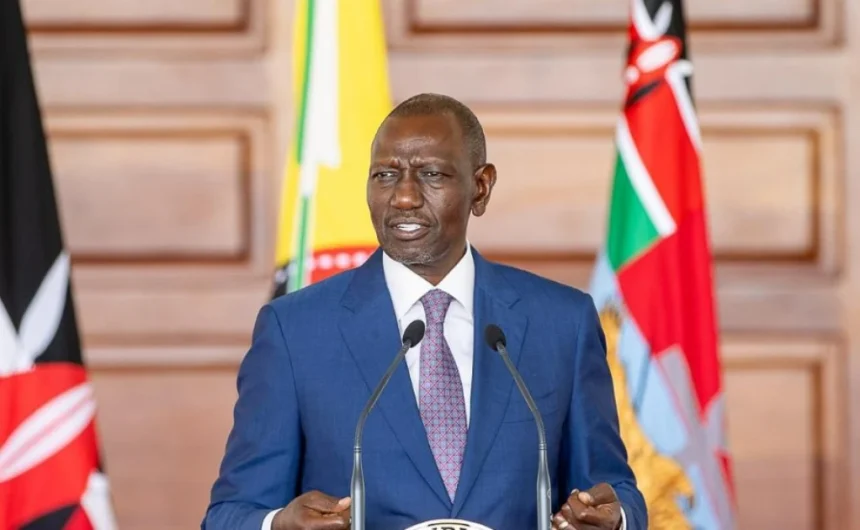
Speaking from Pretoria, South Africa, during an official state visit, President William Ruto broke his silence on the intensifying controversy surrounding a planned U.S.-backed Ebola quarantine facility in Laikipia County.
Addressing a high-stakes press conference, Ruto pushed back directly against local political opposition and public anxiety, framing the facility as a necessary act of international cooperation and regional health security.
The Star
“It would be most unfortunate if on one request by the Americans to set up a facility at their cost, we would refuse. We would look very inhuman. Without fear of any contradiction, and I can look at everybody in the eye… and tell you we are doing the right thing.”
— President William Ruto
The Core of the Controversy
The deal, which was approved following a direct request from Washington, allows the United States to establish a 50-bed isolation and quarantine unit at the Laikipia Air Base in Nanyuki. The facility is intended to monitor and treat American personnel who may be exposed to the deadly Ebola virus while responding to active regional outbreaks.
Internazionale
+ 1
The announcement sparked immediate domestic backlash, culminating in intense protests in Nanyuki town earlier this week where at least two demonstrators lost their lives. Local residents and civil society groups have expressed deep concern over the safety risks of hosting potentially infected foreign nationals, pointing out vulnerabilities within Kenya’s domestic healthcare infrastructure.
The Independent
+ 1
Project Breakdown at a Glance
Factor Details
Location Laikipia Air Base, Nanyuki, Kenya
Capacity 50-bed specialized quarantine and isolation unit
Funding $13 million (approx. KSh 1.8 Billion) fully funded by the U.S. government
Target Disease Bundibugyo strain of Ebola (currently active in DRC and Uganda)
Legal Status Temporarily suspended by the High Court following petitions by LSK and Katiba Institute
Ruto’s Defense: Standing by Long-Term Alliances
Defending the executive decision, President Ruto emphasized that Kenya has enjoyed a robust 30- to 40-year health partnership with the United States, citing monumental investments in programs like PEPFAR for HIV/AIDS, as well as joint operations during the COVID-19 pandemic.
The Star
He sought to reassure anxious citizens by detailing Kenya’s broader defensive measures against the virus:
Wider Infrastructure: The Laikipia unit is just one of 23 separate isolation facilities established across various counties to deal with infectious diseases.
The Star
Enhanced Border Screening: Kenyan border authorities are currently screening between 2,000 and 3,000 travelers daily arriving from high-risk zones.
The Star
No Exclusion Policy: Ruto noted that even without a specialized base, any foreign national falling ill within Kenyan borders would legally and morally receive treatment in local hospitals.
The Star
Regional Exposure: With thousands of Kenyan citizens living, working, and trading in the eastern Democratic Republic of Congo (DRC), the President argued that absolute preparedness is the only responsible course of action.
The Star
A Stalled Project and Rising Legal Tensions
Despite the President’s firm stance, the project remains legally in limbo. The High Court of Kenya recently extended an order temporarily halting any construction at the military base or the arrival of foreign patients. The petition, spearheaded by the Law Society of Kenya (LSK) and the Katiba Institute, argues that the government failed to conduct proper public participation and put local communities at unnecessary risk.
Anadolu Ajansı
+ 2
Satellite imagery, however, indicates that clearing and initial setup of connected medical tents at the air base had already advanced rapidly prior to the latest judicial restrictions. As the diplomatic and legal standoff deepens, the debate looks set to test the boundaries of Kenya’s foreign policy alignments and domestic public health sovereignty.