

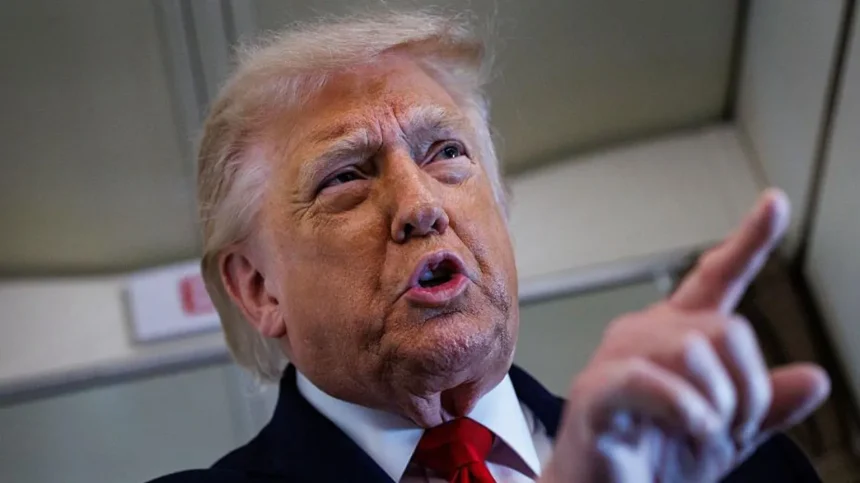
The fragile calm in the Middle East has once again been thrown into doubt after U.S. President Donald Trump warned that the United States could strike Iran “hard again tonight,” while also declaring that the ceasefire “is over.” The remarks have reignited fears of renewed military confrontation between Washington and Tehran, raising concerns among global leaders, financial markets, and millions of people across the region.
Trump’s comments came amid growing uncertainty over whether recent diplomatic efforts to reduce hostilities can survive. Although a ceasefire had offered hope that direct military exchanges might come to an end, the latest statements suggest tensions remain dangerously high.
The developments have drawn worldwide attention because any escalation between the United States and Iran could have consequences far beyond the Middle East, affecting global energy markets, international trade, regional security, and diplomatic relations.
A Fragile Ceasefire Under Pressure
Ceasefires are often designed to provide a pause in fighting and create space for diplomacy. However, they remain vulnerable when either side believes the agreement has been violated or no longer serves its interests.
Trump’s declaration that the ceasefire “is over” signals a sharp deterioration in relations and raises questions about whether negotiations can continue. While governments frequently use strong public statements during periods of tension, military action is not inevitable, and diplomatic channels often remain active behind the scenes.
Officials and analysts are closely monitoring developments to determine whether the rhetoric will translate into further military operations or renewed negotiations.
Why the U.S.–Iran Relationship Matters
The relationship between the United States and Iran has been marked by decades of political rivalry, economic sanctions, and periodic military tensions.
Key issues that have shaped the relationship include:
Iran’s nuclear program.
Regional influence in the Middle East.
Maritime security in the Persian Gulf.
Support for regional allies and proxy groups.
Economic sanctions and international diplomacy.
Because both countries play significant roles in regional security, any increase in hostilities has the potential to affect neighboring states and global markets.
Global Concerns Over Escalation
World leaders are watching the situation closely for several reasons.
A renewed conflict could:
Disrupt oil exports from the Gulf region.
Increase global energy prices.
Affect international shipping routes.
Create humanitarian challenges.
Increase security risks across the Middle East.
Complicate ongoing diplomatic efforts.
Energy markets are particularly sensitive to instability involving major oil-producing regions, making geopolitical developments an important factor for businesses and consumers worldwide.
Diplomatic Efforts Continue
Despite the strong language from political leaders, diplomacy often continues behind closed doors during periods of crisis.
Regional governments, international organizations, and key allies frequently work to encourage restraint and prevent further escalation. Negotiations may involve direct talks, third-party mediation, or back-channel communications aimed at reducing misunderstandings and avoiding unintended conflict.
Whether these efforts succeed will depend on decisions made by leaders in the coming days.
Potential Impact on the Global Economy
Markets typically react quickly to geopolitical uncertainty.
Investors often monitor developments involving the Middle East because the region is critical to global energy supplies. Increased tensions can influence:
Oil and gas prices.
Stock market performance.
Currency movements.
Shipping costs.
Airline operations.
Investor confidence.
However, the long-term economic impact will depend on whether the situation escalates or returns to diplomatic negotiations.
What Happens Next?
Several scenarios remain possible:
Renewed diplomatic engagement.
Continued political rhetoric without military action.
Additional sanctions or economic measures.
Limited military operations.
Broader regional escalation.
At this stage, it is impossible to predict which path events will take. Governments are continuing to assess the situation while monitoring military and diplomatic developments.
Conclusion
Donald Trump’s warning that the United States could strike Iran again, combined with his statement that the ceasefire “is over,” has intensified concerns about stability in the Middle East. While the rhetoric has raised fears of renewed conflict, the situation remains fluid, and diplomatic efforts may still influence the outcome.
For now, the international community is watching closely as governments seek to balance national security concerns with the need to avoid a wider regional crisis. The coming days are likely to be critical in determining whether tensions escalate further or whether diplomacy can restore a measure of stability.