
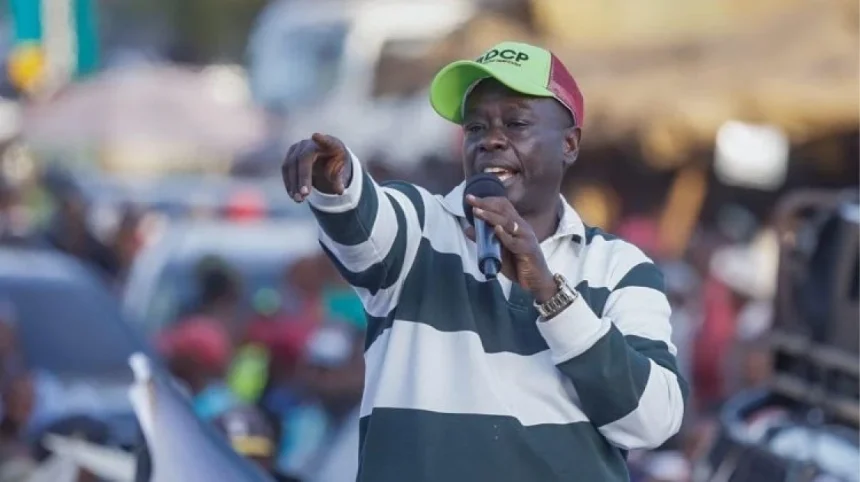
In the dusty plains of Melil Ward, Narok North, the political air on February 14, 2026, was thick with more than just the usual campaign rhetoric. It was thick with the scent of a scorched-earth political war. Former Deputy President Rigathi Gachagua, now the leader of the Democracy for the Citizens Party (DCP), stood before a sea of supporters to deliver what many are calling his most lethal counter-offensive yet.
The target? His former boss, President William Ruto. The trigger? A scathing accusation from Mandera just two days prior that Gachagua was a “petty thief” who once stole relief food meant for the hungry.
1. The Spark: Ruto’s Mandera “Petty Thief” Jab
On February 12, 2026, during a tour of Mandera County to launch the NYOTA youth fund, President Ruto broke his usual silence regarding his former deputy. Addressing a crowd that had gathered to hear about government drought mitigation, Ruto took a sharp detour into Gachagua’s civil service history.
“We know your record. You were fired from your job as a District Officer (DO) because you were stealing relief food meant for hungry Kenyans. You are a petty thief who lacks the moral authority to lecture this government on poverty,” Ruto declared.
The President’s remarks were intended to de-legitimize Gachagua’s growing “Hustler-Defense” movement, painting him as a man who profited from the very desperation he now claims to represent.
2. The Narok Response: “Who is the Bigger Thief?”
Gachagua did not wait long to respond. Attending a homecoming ceremony for Martin Ole Kamwaro in Narok on Saturday, February 14, he turned the “thief” label on its head.
The “Kasongo” Nickname
Gachagua repeatedly referred to the President as “Kasongo,” a nickname he has popularized to imply a “fast-talking trickster.”
“I am amazed,” Gachagua told the cheering crowd in Swahili, “that the ‘Great Thief’ can have the audacity to speak about a ‘petty thief.’ If there is a petty thief who is unknown, how can the biggest thief in the world talk about him?”
The Corrupt Leader Allegation
Gachagua went further, making the sensational and unsubstantiated claim that President Ruto had been ranked as the “second most corrupt leader globally.” While the source of this “ranking” remains unclear, the rhetoric was designed to pivot the conversation from Gachagua’s 1990s civil service record to Ruto’s massive current wealth.
3. The Land Grabbing Dossier: Gachagua’s Specific Targets
If the “petty thief” comment was a jab, Gachagua’s response was a heavy-weight hook. He listed several high-profile land parcels he alleged the President had acquired through questionable means.
“You stole 2,800 acres in Kibiko and sold it for billions, and then you have the nerve to talk about relief food? Give the Wamaasai back their land before you call anyone a thief!” Gachagua thundered.
4. The “One-Term” Crusade: The 2027 Calculus
The exchange reveals the core strategy of the Democracy for the Citizens Party (DCP). Gachagua is no longer just defending his record; he is running a “One-Term President” campaign.
Why the Maa Community Matters
By choosing Narok as the venue for this response, Gachagua is intentionally courting the Maasai vote—a crucial swing bloc that has traditionally felt marginalized by land-grabbing scandals. By framing Ruto as a “land predator,” Gachagua hopes to strip away the President’s support in the Rift Valley and the South Rift.
The Kindiki Factor
Current Deputy President Kithure Kindiki has attempted to act as a buffer, dismissing Gachagua’s claims as the “last kicks of a dying political horse.” However, the sheer volume of the Narok crowd suggests that Gachagua’s “Us vs. Them” narrative is resonating with those who feel the economic pinch of 2026.
5. The Fallout: EACC and Legal Implications
The “relief food” allegations have prompted calls for the Ethics and Anti-Corruption Commission (EACC) to produce the 1990s files. Gachagua’s supporters argue that if he was indeed fired for theft, he would never have been cleared to run for DP in 2022. Conversely, the land allegations made by Gachagua in Narok could lead to defamation suits or a renewed scrutiny of the President’s vast business empire.
Conclusion: The End of Political Civility
The events of February 14, 2026, signify the total collapse of political decorum in Kenya. When a President and his former Deputy trade “thief” labels on national television, the “Broad-Based” unity of 2024 is officially dead.
The 2027 election will not be fought on manifestos alone; it will be a battle of “The Records.” Voters are now left to decide: Is Gachagua a “petty thief” of the past, or is Ruto a “bigger thief” of the present?
What do you think? Has Gachagua successfully turned the tables on the President, or will the “relief food” stigma haunt his 2027 ambitions? Let us know in the comments below.