
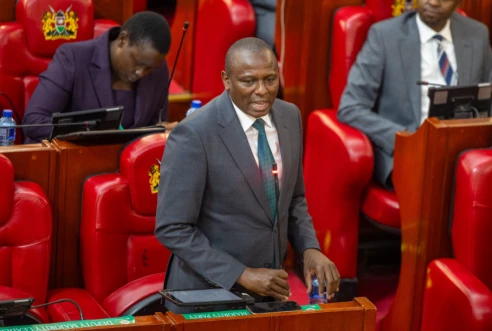
The corridors of Parliament were unusually tense on February 18, 2026, as Majority Leader Kimani Ichung’wah dropped a bombshell that has shifted the national conversation from economic woes to a burgeoning human rights crisis. According to Ichung’wah, a well-coordinated “rogue network” involving high-ranking state officials and private recruitment agencies has successfully trafficked at least 1,000 young Kenyans into the Russian military machine.
1. The Bait-and-Switch: “From Security Guards to Soldiers”
The expose details a sophisticated recruitment pipeline that preys on Kenya’s unemployed youth.
The Promise: Recruits were allegedly offered lucrative jobs as security guards, drivers, or factory workers in Russia, with signing bonuses as high as $7,000 (Sh900,000) and monthly salaries exceeding $1,900.
The Reality: Upon arrival in St. Petersburg or Moscow, their passports were reportedly confiscated. They were forced to sign contracts written in Russian—which they could not read—and were given as little as one week of combat training before being shipped to occupied territories like Donetsk and Kharkiv.
2. The “Rogue State Network” Allegations
Ichung’wah’s most damaging claim is that this is not merely a case of “scammers,” but a “state-sanctioned” operation.
Bureaucratic Complicity: He alleged that certain officials within the Ministry of Labor and the Directorate of Immigration facilitated the processing of documents at “lightning speed,” bypassing standard vetting protocols for labor export.
Global Face Human Resource Ltd: Ichung’wah named specific agencies, including some already under investigation like Global Face Human Resource Ltd, claiming they acted as front organizations for the trafficking ring.
The Russian Link: He hinted at a collaboration between these rogue agents and Russian embassy officials, referencing the recent deportation of Mikhail Lyapin, who was previously linked to a recruitment ring in Nairobi.
3. The Humanitarian Toll: Families in Mourning
As the number of victims climbs, stories of trauma are flooding Kenyan media.
The Voice Note from the Front: The story of 22-year-old David Kuloba, who sent a final voice note to his mother saying, “I am heading into battle and might not survive,” has become the face of the tragedy.
The POWs: At least 15 Kenyans are currently believed to be held as Prisoners of War (POWs) by Ukrainian forces. The Kenyan government is reportedly in sensitive negotiations with Kyiv for their repatriation.
4. The Government’s Fragile Defense
While Ichung’wah (a key ally of President Ruto) is leading the charge for accountability, other sectors of the government are in damage control.
Prime CS Musalia Mudavadi has warned Kenyans to be “extremely cautious” of unrealistically attractive job offers, but critics argue the state is shifting blame onto the victims for “bypassing official channels.”
Investigation Launched: Principal Secretary Korir Sing’Oei has confirmed an inter-agency probe into the 1,000+ figure, promising that any government official found complicit will face the full force of the law.
Conclusion: A Moral Crossroads for Kenya
Ichung’wah’s expose has forced a difficult question: Is Kenya’s aggressive “Labor Export” policy accidentally creating a pipeline for modern-day slavery? As 1,000+ families wait for news from the freezing trenches of the Donbas, the “rogue network” in Nairobi remains the primary target of public fury.