
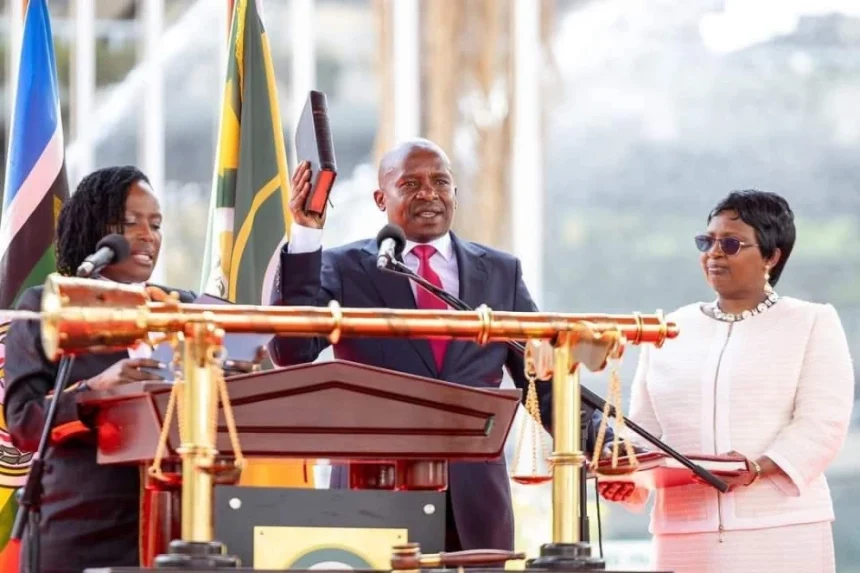
In a monumental judicial determination that permanently alters Kenya’s constitutional landscape, the High Court has firmly upheld the appointment and swearing-in of Prof. Kithure Kindiki as the Deputy President of the Republic of Kenya.
Delivering the highly anticipated judgment on Monday, June 8, 2026, a three-judge bench definitively threw out petitions challenging Kindiki’s assumption of office, declaring that filling a mid-term vacancy in the presidency’s second-in-command does not legally require public participation.
The ruling brings an end to over a year and a half of bitter legal warfare initiated by former Deputy President Rigathi Gachagua following his historic impeachment by Parliament in October 2024.
The Core Finding: Delegated Sovereign Authority
The bench, comprising Justices Eric Ogola, Anthony Mrima, and Dr. Freda Mugambi, focused directly on the mechanics of Article 149 of the Constitution of Kenya, which dictates how a vacancy in the office of the Deputy President is filled.
Gachagua’s legal team had aggressively argued that the sudden nomination and fast-tracked approval of Kindiki lacked meaningful public consultation, violating foundational constitutional principles. However, the judges completely decoupled mid-term executive appointments from the stringent public participation thresholds required during standard lawmaking.
The court clarified that the process is strictly adjudicative and procedural rather than consultative.
“The approval of a Deputy President nominee for appointment as the substantive Deputy President does not require public participation. In undertaking such approval, Parliament exercises delegated sovereign authority on behalf of the people, as provided for under the Constitution.”
— High Court Three-Judge Bench
Inside the Verdict: Why Article 149 Differs From Regular Legislation
To guide the legal and political fraternities, the High Court provided a clear structural breakdown distinguishing between routine legislative functions that demand national public participation and the fast-tracked filling of an executive vacancy.
Constitutional Mechanics: Lawmaking vs. Executive Succession
Category Factor Routine Parliamentary Legislation Article 149 Executive Succession
Constitutional Basis Articles 118 and 196 Article 149 (Filling mid-term DP vacancy)
Process Nature Consultative: Requires collection of public memoranda, town halls, and stakeholders’ input. Procedural & Adjudicative: Focused on vetting qualifications and rapid state continuity.
Public Representation Direct citizens’ engagement is a mandatory threshold to avoid constitutional invalidation. Executed via Delegated Authority, meaning elected MPs vote as direct proxies for their constituents.
Time Constraints Open-ended or governed by standard legislative calendars. Strict constitutional timelines to ensure no prolonged vacuum exists in the Presidency.
Impeachment Upheld But Parliament Put on Notice
While the bench officially regularized Kindiki’s status, the judgment contained a sharp reprimand directed at Parliament regarding the vague frameworks surrounding the removal of a Deputy President under Article 150.
The judges pointed out a worrying legal gap: the absolute absence of a comprehensive statutory framework governing the impeachment processes of a Deputy President. They warned that leaving such crucial procedural questions to ad-hoc parliamentary standing orders risks undermining public confidence and institutional stability.
Consequently, the court ordered Parliament to urgently draft and enact a dedicated piece of legislation specifically regulating future impeachment proceedings under Article 150. Crucially, however, the bench maintained that this structural gap did not invalidate Gachagua’s 2024 ouster, noting that Articles 144 and 145 provided the bare minimum protections necessary to safeguard the former DP’s rights during the trial.
Political Implications: Cementing the Status Quo
This landmark ruling serves as an absolute triumph for President William Ruto’s administration, effectively removing the cloud of legal illegitimacy that critics had attempted to pin to Deputy President Kithure Kindiki since late 2024.
With the High Court locking the legal doors on Gachagua’s return, the political ecosystem shifts fully into election planning mode ahead of the 2027 polls. Kindiki’s position as the official number two is now constitutionally unassailable, giving him the institutional legal backing to solidify his political footprint across the crucial Mount Kenya region and the wider nation.
Blogger’s Content Expansion Options
Follow-Up Angle 1 (Legal Focus): Analyze the historic KSh 50 Million compensation awarded to Gachagua in the same ruling despite his ouster being upheld.
Follow-Up Angle 2 (Political Focus): How Mount Kenya is reacting to the final judicial seal on the Gachagua vs. Kindiki power shift.
To watch the live broadcast of the judges delivering this historical constitutional breakdown at the Milimani Law Courts, you can view the video segment Justice Freda Mugambi reads the Kindiki DP appointment ruling. This clip provides the exact legal text read out by the bench regarding the consolidated petitions challenging the legitimacy of the current Deputy President.