

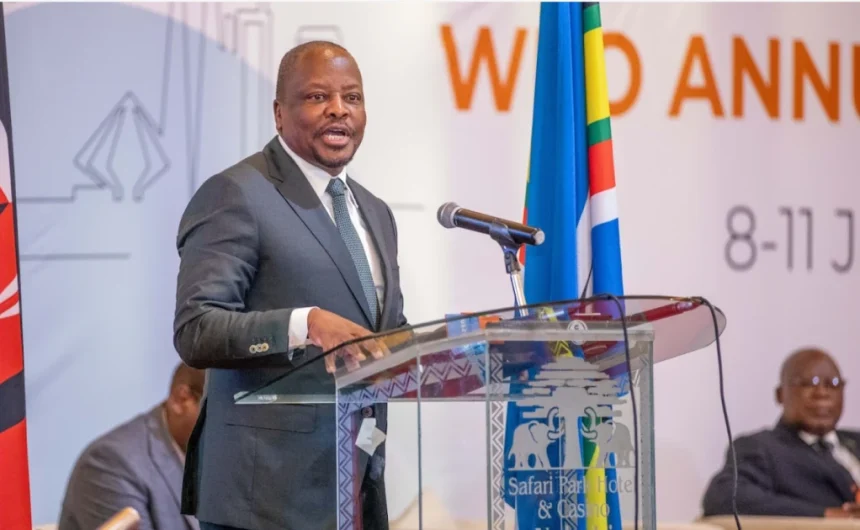
In a fiercely direct address that has resonated across the global agricultural sector, Kenya’s Agriculture and Livestock Development Cabinet Secretary, Mutahi Kagwe, has called for an immediate end to international “double standards” governing the trade of toxic agrochemicals.
Citizen Digital
Speaking during the grand opening ceremony of the 2026 World Farmers’ Organisation (WFO) General Assembly in Nairobi on Monday, June 8, 2026, Kagwe took aim at multinational manufacturers and foreign regulators. He questioned the morality of chemical companies exporting highly hazardous pesticides (HHPs) to developing nations despite those same substances being strictly banned on their own home soils due to severe health and environmental risks.
Citizen Digital
+ 1
Shifting the Target from Production to People
Kagwe’s remarks mark a fundamental policy shift for the ministry, moving away from a pure focus on harvest yields toward prioritizing human longevity and ecological protection.
“The world cannot continue operating under a double standard when it comes to agricultural chemicals. If a pesticide is considered unsafe for use in one country because it poses unacceptable risks to human health or the environment, it should not find a market elsewhere simply because farmers are poorer or regulations are weaker. The life of an African farmer is not worth less than the life of a farmer in any other part of the world.”
Sacco Review
— CS Mutahi Kagwe at the WFO Assembly
The CS noted that the current regulatory asymmetry essentially uses developing nations as dumping grounds for chemical formulations that are known to cause severe chronic illnesses, including rising cancer clusters in intensive farming regions like Meru and Nyandarua.
The Proliferation of Fake and Toxic Inputs
Compounding the crisis of legal but highly hazardous imports is the massive parallel threat of completely illicit farm inputs. Kagwe warned that unregulated distribution networks, informal border crossings, and outright counterfeiting are actively sabotaging Kenya’s food security and undermining lucrative international export markets.
Citizen Digital
+ 1
According to data tracking agricultural vulnerabilities, crop protection materials remain highly susceptible to illegal counterfeiting loops:
The Counterfeit Burden in Kenyan Agriculture
Input Category Percentage of Total Counterfeit Cases Market-Wide Primary Local Consequence
Pesticides, Insecticides & Herbicides 89.16% Direct exposure to unknown toxic chemicals; immediate destruction of target crops; residue rejection at EU borders.
Fertilizers & Soil Conditioners 54.29% Severe soil acidification; stunted crop development; massive financial losses for smallholders.
Certified Crop Seeds 45.60% Total germination failure; introduction of aggressive, non-indigenous crop diseases into clean soil.
Animal Feeds & Vet Medicine 34.09% Livestock poisoning; localized chemical contamination of commercial milk and meat supply chains.
Moving Beyond Laboratories: The Digital and Enforcement Strategy
To back his aggressive rhetoric with actionable governance, CS Kagwe outlined a multi-layered local strategy designed to decouple Kenya from toxic dependency.
The Origin-Matching Rule: Building on policy frameworks initiated over the past year, the ministry is tightening enforcement to ensure that any agrochemical molecule seeking registration in Kenya must prove active approval and use within its country of origin.
Capital FM
Leveraging KIAMIS for Traceability: Kenya is scaling up the Kenya Integrated Agricultural Management Information System (KIAMIS). This digital, data-driven framework tracks subsidies, inputs, and crop lifecycles, ensuring full transparency from the manufacturing plant directly to the smallholder’s farm.
Citizen Digital
+ 1
Empowering Grassroots Innovation: Kagwe challenged local researchers and institutions like KALRO to bridge the gap between academic journals and practical reality by accelerating the development of organic, biologically safe, and affordable pest-management alternatives.
KBC Digital
Putting the Missing Center Back into Policy
The overarching message of the 2026 Nairobi Summit is clear: global discussions regarding climate adaptation, agricultural financing, and value chain optimization are fundamentally broken if they continue to treat the individual farmer as a minor asset.
The Star
By demanding an international harmonization of safety standards, Kenya is pushing a bold global narrative. Food safety, consumer confidence, and sustainable public health do not begin at the supermarket shelf—they begin in the soil, protected by the health and dignity of the person holding the tools.
Citizen Digital
To better understand the historical context behind the Ministry of Agriculture’s ongoing battle against toxic agrochemicals and its regional enforcement strategy, watch CS Mutahi Kagwe calls for COMESA to impose a regional ban on hazardous pesticides. This video is highly relevant as it showcases how Kenya’s current push for a global ban at the 2026 WFO Assembly is an escalation of the minister’s long-standing regional campaign to eliminate dangerous farm inputs across Africa.
CS Mutahi Kagwe calls for COMESA to impose a regional ban on hazardous pesticides
NTV Kenya · 590 views