

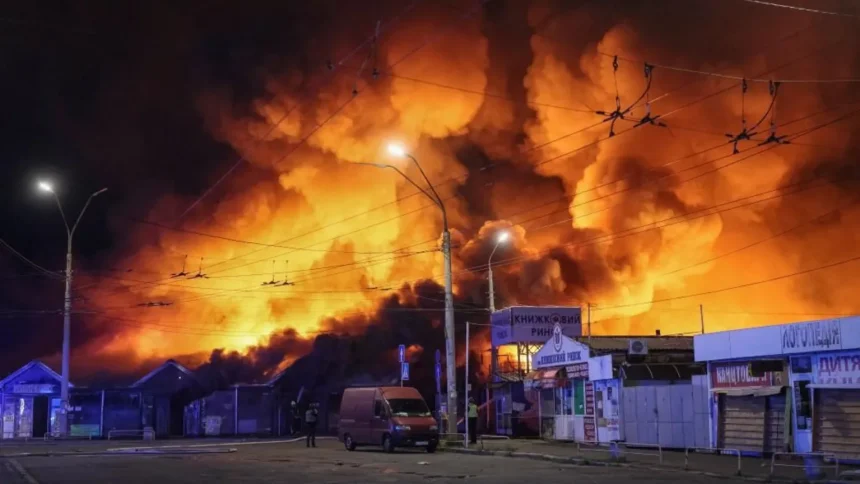
In what Russian officials are calling the largest long-range aerial assault of 2026, a massive swarm of Ukrainian drones targeted multiple regions across the Russian Federation overnight. According to statement updates from local governors and the Russian Ministry of Defense, at least seven people were killed and dozens more were injured as strikes hit energy grids, industrial hubs, and transport infrastructure.
The scale of the attack underscores a major shift in deep-strike capabilities, with Russian air defense systems engaged across several administrative districts simultaneously. Moscow and border regions bore the brunt of the offensive, which severely disrupted civilian aviation, damaged commercial logistics infrastructure, and left residential areas without power.
The operation marks a significant intensification of long-range warfare, with both nations increasingly relying on unmanned aerial vehicles (UAVs) to strike targets hundreds of kilometers behind the active front lines in Eastern Europe.
Russian Regions Hit by the Drone Wave
The overnight offensive affected multiple regions across western and central Russia, stretching from border zones deep into the capital region.
Moscow District Targeted
Regional authorities reported an unprecedented wave of incoming UAVs directed toward the Moscow capital area.
Scale: Moscow Mayor Sergei Sobyanin and defense officials stated that local air defenses intercepted or jammed hundreds of incoming drones. Local media reported around 600 drones directed toward the broader metropolitan area.
Casualties: Moscow Region Governor Andrey Vorobyov confirmed that an 83-year-old man was killed when debris from a intercepted drone struck a private residence in the Ramensky district.
Logistics Damage: Fires broke out across industrial hubs in the suburban outskirts. A massive fire damaged a Wildberries distribution warehouse in Podolsk, while a major pharmaceutical logistics center in Domodedovo sustained severe structural impact.
Fatalities in Southern Border Regions
The highest concentration of casualties occurred in southern provinces bordering or near Ukrainian territory:
Rostov Region: Governor Yury Slyusar confirmed that five people lost their lives following a coordinated strike involving over 150 drones. The attack targeted regional transport networks, damaged power supply lines, and ignited fires in residential structures.
Belgorod Region: Acting Governor Aleksandr Shuvayev reported one civilian fatality and nine injuries when a drone struck a commuter bus transporting industrial shift workers near the border.
Air Transit and Logistics Disruptions
The widespread drone presence caused widespread logistical paralysis across central transport nodes in Russia.
Federal aviation agencies temporarily halted operations across Moscow’s primary international hubs—including Sheremetyevo, Domodedovo, and Vnukovo airports. Over 150 domestic and international flights were delayed, diverted, or canceled as air defense protocols went into effect.
The strikes also exposed vulnerabilities in supply chain corridors, particularly around the Podolsk and Domodedovo industrial belts, where major retail and medical delivery networks experienced operational halts due to warehouse fires.
Simultaneous Russian Counter-Strikes Reported
The drone offensive occurred alongside reciprocal long-range bombardments directed at Ukrainian industrial and municipal centers.
Ukrainian military authorities and local administration headers reported that Russian missile and drone counter-strikes overnight killed at least seven individuals across several regions:
Kryvyi Rih & Zaporizhzhia: Precision missile strikes hit energy supply points and industrial districts.
Sumy & Donetsk: Artillery and glide-bomb attacks targeted frontline staging locations and civilian infrastructure.
Kyiv Suburbs: Drone interceptions were reported near manufacturing facilities surrounding the capital city.
Both nations continue to ramp up domestic production of autonomous strike systems, signaling that long-range aerial engagements will remain a core component of the conflict’s ongoing dynamics in 2026.