

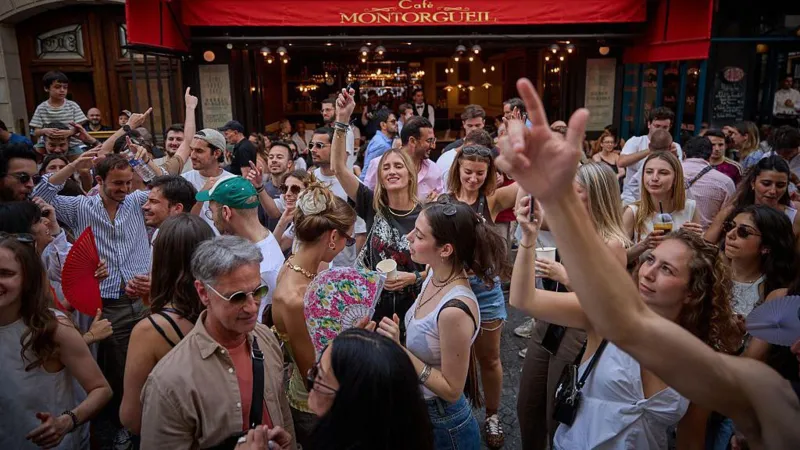
In an unprecedented move that has stunned millions of festivalgoers, the French government has officially banned public alcohol consumption across more than a third of the country during its most celebrated national street music event. The emergency mandate, issued ahead of the annual Fête de la Musique, comes as a punishing, historic summer heatwave clamps down on Western Europe.
With national forecasters issuing maximum “Red Alerts” for 35 of France’s 96 regional departments—including the capital city of Paris—temperatures are projected to skyrocket between 39°C and 41°C, threatening to break all-time weather records. Crisis at the Solstice: The Alcohol Prohibition BlueprintThe Fête de la Musique, which has run for over 40 years to mark the summer solstice, typically turns the streets of France into a massive open-air party. Last year alone, the free concerts drew nearly two million revellers to Paris.
However, following an emergency crisis meeting chaired by Prime Minister Sébastien Lecornu, the government determined that the combination of extreme heat and heavy drinking posed too great a risk to public health and critical infrastructure. Core Restrictions of the DecreeThe emergency restrictions went into effect starting at noon on Sunday, introducing several sweeping measures: Public Space Prohibited: The consumption of alcohol is entirely banned in all public open spaces, street venues, and public thoroughfares within the 35 red-alert departments.
State Sanctioned Dry-Out: For any official musical event organized or funded directly by the state and its public agencies, instructions have been given that no alcohol may be sold or offered. Hospital Protection Protocol: The Prime Minister’s office explicitly stated the ban was enacted to limit alcohol-related emergency calls, thereby preserving medical resources so healthcare staff can focus entirely on treating vulnerable populations suffering from heat exhaustion. 26 Million Under Red Alert: The Meteorological RealityThe highest danger alert issued by Météo-France covers an expansive geographic corridor stretching southwest from Paris down into the heart of Burgundy. According to census calculations, the red alert zone directly impacts roughly 26 million people—more than three-quarters of mainland France’s population when combined with the 45 neighboring departments placed on secondary “Orange” alerts. [ Total French Departments ]
│
┌─────────────────────┴─────────────────────┐
▼ ▼
[ 35 Departments ] [ 45 Departments ]
CRITICAL RED ALERT ELEVATED ORANGE ALERT
(Alcohol Banned in Public) (High Heat Monitoring)
Forecasters warn that the urban heat island effect is severely magnifying conditions in major concrete centers like Paris. To help locals and tourists cope with suffocating indoor temperatures, municipal authorities in the capital have ordered all major parks, public squares, and guarded gardens to remain unlocked and open 24 hours a day to provide overnight cooling spaces.
Countrywide Disruption: Heatwave Overpowers InfrastructureThe extreme weather is causing disruptions far beyond the music industry:Rail Grid Meltdown: The national rail operator has been forced to cancel dozens of regional train routes due to fears that extreme track temperatures will cause steel rails to warp or buckle under heavy transit loads. Educational Stalls: Secondary school classes and regional examinations have been temporarily suspended in heavily impacted southern zones to keep children out of un-airconditioned school buildings.
European Spillover: The heatwave is sweeping across the continent. Germany has issued blanket warnings as temperatures approach 38°C, while in Spain, football fan zones featuring giant outdoor screens have been entirely dismantled to keep fans from gathering in unshaded public squares. As musicians still take to the streets of Paris to play acoustic and electronic sets under a baking afternoon sun, the vibe remains undeniably subdued. While the music continues, the lack of traditional midsummer drinking marks a historic shift in how Europe is being forced to adapt its cultural footprint to combat changing climate realities.