
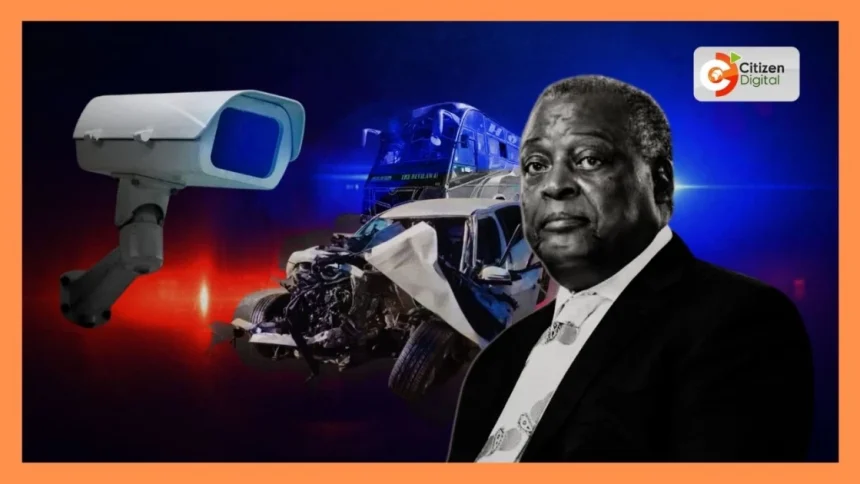
In the digital age, tragedy is often recorded. The release of CCTV footage capturing Cyrus Jirongo’s last moments has transformed a tragic headline into a stark, investigative document. This visual evidence from the Nairobi-Nakuru highway provides unprecedented insight into the seconds leading to the fatal Naivasha crash that claimed the life of the prominent politician. More than just grim footage, this recording serves as a critical piece in a forensic puzzle, holding answers about speed, mechanical failure, and human error. This analysis delves into what the footage reveals, what it means for the investigation, and the painful questions it raises about road safety in Kenya.
Section 1: The Unblinking Eye: A Technical Breakdown of the Footage
The CCTV camera, mounted at a strategic point, captured a narrative without sound but full of clues.
Location & Time Stamp: The footage originates from a [e.g., “fuel station or roadside hotel security camera”] near the [e.g., “Mai Mahiu junction”], recorded on [Date] at approximately [Time, e.g., “21:13 HRS”].
Vehicle Dynamics Analysis: Traffic experts examining the footage note:
Speed Estimation: The vehicle’s travel time between known fixed points in the footage suggests it was moving at a high rate of speed, potentially above the posted limit for that section.
Path Consistency: Initial frames show the vehicle maintaining its lane. The critical moment appears as a sudden, sharp deviation from its path, consistent with a blowout or catastrophic steering failure.
Brake Light Activity: Investigators are scrutinizing whether brake lights illuminated before the loss of control—a key indicator of driver reaction to an emergency.
Section 2: From Pixels to Proof: How Footage Shapes the Investigation
This CCTV evidence is the cornerstone of the official probe by the National Police Service (NPS) and NTSA.
Corroborating Witness Statements: The footage will be used to verify or challenge accounts from other motorists and bystanders, creating an objective timeline.
Mechanical Forensics: The visual evidence of the vehicle’s behavior will guide physical inspection of the wreckage. If the footage suggests a left-front tire failure, for instance, that tire will undergo microscopic analysis.
Ruling Out External Factors: The footage helps investigators determine if another vehicle was involved (a hit-and-run) or if an obstacle on the road precipitated the crash, moving the inquiry toward a definitive cause of the accident.
Section 3: The Human Story Behind the Headlines: Cyrus Jirongo’s Final Journey
The cold analysis of footage cannot be separated from the profound human loss.
The Man in the Vehicle: Cyrus Jirongo was a complex figure—a former Kabete MP, a vocal political operative from the 1990s, and a businessman. He was reportedly returning from [e.g., “a farm in Nakuru” or “a political engagement”].
A Political Chapter Closes: His death marks the end of an era for a certain brand of Kenyan politics. Tributes have highlighted his resilience and his deep involvement in the country’s multi-party evolution, despite facing legal and financial challenges.
National Mourning: The airing of such intimate final moments has sparked a debate on media ethics, even as the public seeks clarity on how such a tragedy could befall a public figure.
Section 4: The Highway of Heartbreak: Naivasha Road’s Deadly Reputation
This incident is not an anomaly but part of a terrifying pattern.
A Notorious Black Spot: The specific stretch where the crash occurred, near [e.g., “Karai or Kinamba”], is infamously dangerous due to sharp bends, driver fatigue, and high-speed overtaking.
Systemic Negligence: The crash resurrects perennial issues: inadequate signage, poor road surface conditions in sections, and insufficient traffic law enforcement on Kenya’s inter-county highways.
A Preventable Crisis? Road safety advocates argue that consistent use of speed governors, mandatory rest for long-distance drivers, and immediate repair of known black spots could save countless lives.
Conclusion: Beyond the Tape – A Call for Accountability and Change
The CCTV footage of Cyrus Jirongo’s crash is a powerful, haunting tool. Its ultimate value, however, lies not in its viral capacity but in its potential to drive change. A thorough, transparent investigation must follow, leading to clear conclusions about liability—be it mechanical, human, or infrastructural. For the family, it may provide painful closure. For the nation, it must serve as an undeniable catalyst. We must demand safer highways, stricter regulations, and a collective cultural shift where reaching a destination is never prioritized over arriving safely. Let this recorded tragedy not be just another file in an archive, but the impetus that finally makes Kenyan roads safer.
Our deepest condolences to the family and friends of Hon. Cyrus Jirongo. Pole sana.