
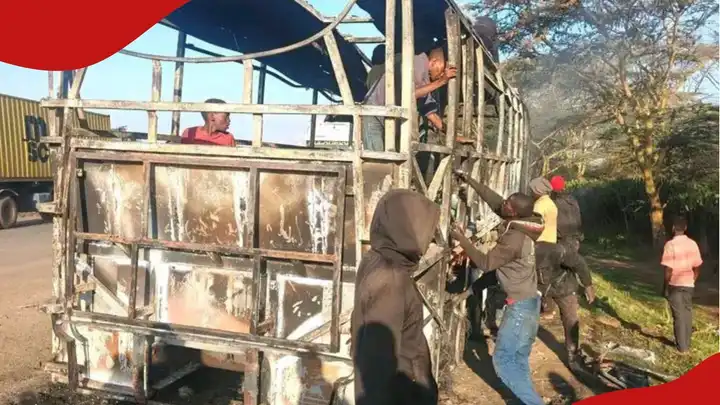
Kenya’s grim road safety record was dealt another devastating blow today as a major collision between a bus and a boda boda rider on the Nakuru-Eldoret highway in Salgaa erupted into a catastrophic fireball. Initial reports indicate the bus, belonging to a major transport company, was completely burnt to ashes, leaving behind only a charred, skeletal frame. While the exact number of casualties remains unclear, the boda boda rider is confirmed dead at the scene, and fears are mounting for passengers on the bus. This latest tragedy spotlights, once again, the lethal cocktail of high speeds, mixed traffic, and perilous conditions on what remains one of Kenya’s most infamous “black spot” highways.
Section 1: The Scene of Carnage: What We Know So Far
Piecing together eyewitness accounts and preliminary police statements paints a horrifying picture.
Location & Time: The accident occurred in the Salgaa area along the Nakuru-Eldoret highway in the early hours of the morning. This specific stretch has been the site of countless fatal crashes for decades.
The Sequence of Events: Preliminary reports suggest the bus, traveling at high speed, collided with a boda boda that was either crossing or joining the highway. The impact was severe, likely causing an immediate rupture of the bus’s fuel tank or lines.
Rapid Inferno: The spilled fuel ignited almost instantly, engulfing the entire bus in flames within minutes. The intensity of the fire made immediate rescue efforts extremely dangerous and hampered the ability to determine the passenger count quickly.
Emergency Response: Fire engines from Nakuru County battled the blaze. Survivors, if any, were rushed to nearby hospitals, including the Nakuru Level 5 Hospital. Recovery of bodies from the wreckage is ongoing and expected to be a painstaking process.
Section 2: The Human Cost: Grief, Questions, and Accountability
Behind the smoke and twisted metal are shattered lives and unanswerable questions.
The Deceased Boda Rider: A life lost, likely a young man supporting a family. His identity and the circumstances leading to the collision are under investigation.
The Anxious Wait for Families: For families of bus passengers, this is a nightmare. With the vehicle burnt beyond recognition and passenger manifests sometimes informal, the agonizing wait for confirmation of their loved ones’ fate begins. Social media is flooded with pleas for information.
The Systemic Failure: This is not an “accident” in the pure sense of the word. It is the predictable outcome of a system that has failed for years. Questions will be asked: Was the bus speeding? Was it roadworthy? Were there functioning emergency exits? Was the boda boda rider properly licensed and trained? The answers often point to a collective negligence.
Section 3: Salgaa: Kenya’s Eternal Road Safety Shame
The name “Salgaa” has become synonymous with death on Kenyan roads.
A Notorious History: This area, with its long, deceptive stretches and history of reckless driving, has claimed thousands of lives. Past governments have pledged to dual the highway, install speed cameras, and increase patrols, yet carnage continues unabated.
The Mixed Traffic Menace: The fundamental design flaw is the mix of high-speed long-distance buses and trucks with vulnerable motorcycles (boda bodas), pedestrians, and slow-moving vehicles on a single carriageway. There is no separation, no margin for error.
A Monument to Neglect: Every crash in Salgaa is a direct indictment of the National Transport and Safety Authority (NTSA), the Kenya National Highways Authority (KeNHA), and the traffic police. It represents a catastrophic failure in enforcement, engineering, and policy.
Section 4: Beyond Mourning: The Urgent, Non-Negotiable Demands
Thoughts and prayers are not enough. Concrete, immediate action is required.
Immediate Enforcement Surge: A permanent, 24/7 traffic police and NTSA presence in Salgaa with speed guns and zero tolerance for overloading, speeding, and unroadworthy vehicles.
Emergency Road Engineering: Immediate installation of rumble strips, improved signage, street lighting, and temporary traffic calming measures while the long-promised dual carriageway remains in planning.
Public Inquiry & Accountability: A swift, public, and conclusive investigation must name liable parties—be it the bus company, the driver, or regulatory bodies. Compensation for victims’ families must be fast-tracked.
Boda Boda Sector Reform: This tragedy underscores the need for mandatory, standardized training, licensing, and insurance for all boda boda operators, and the creation of dedicated lanes or routes where possible.
Conclusion: Ashes That Must Ignite Change
The bus burnt to ashes in Salgaa is a grotesque monument to our national apathy towards road safety. Those ashes are not just from metal and seats; they are from dreams, livelihoods, and futures. We have normalized this violence on our roads.
This cannot be another statistic followed by temporary outrage and empty promises. The families of the victims deserve more. Every Kenyan who uses that highway deserves more. It is time to stop calling Salgaa a “black spot” and start calling it what it is: a national emergency and a disgrace.