
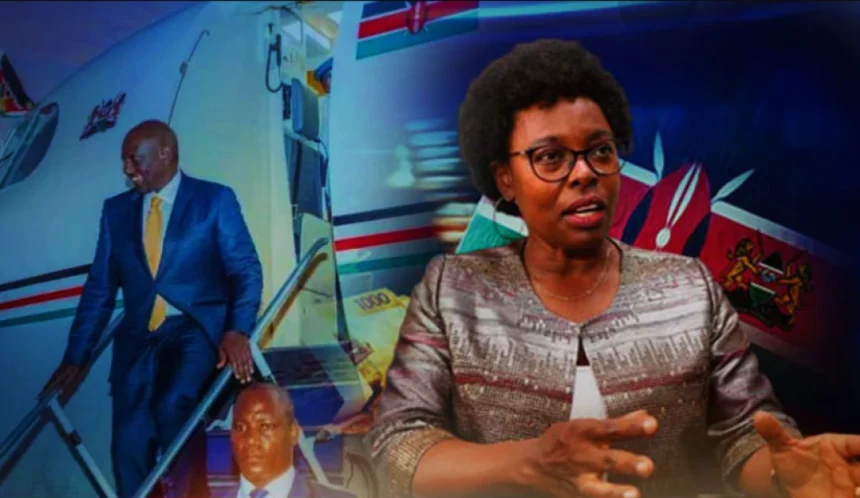
Despite persistent executive declarations and public promises of fiscal discipline, the national government has once again drawn the ire of taxpayers. A damning new report from the Controller of Budget (CoB), Margaret Nyakang’o, has exposed a blatant defiance of austerity measures across top state organs.
Citizen Digital
+ 1
The latest nine-month expenditure report reveals that between July 2025 and March 2026, the government spent a staggering Ksh.17.3 billion on domestic and foreign travel, alongside Ksh.4.9 billion on hospitality.
Citizen Digital
The figures paint a vivid picture of a ruling class largely insulated from the economic hardships confronting ordinary citizens, with Parliament and State House flagged as the leading spenders on luxury and globetrotting.
Citizen Digital
Shifting the Burden: A Recurrent Expenditure Crisis
The Controller of Budget’s review shows that the national government spent a total of Ksh.3.4 trillion by March 2026. However, the allocation of these funds highlights a deeply rooted structural issue in Kenya’s public finance management:
Citizen Digital
Recurrent Expenditure: Ksh.2.9 trillion (85%) went toward running the government, salaries, travel, and operations.
Citizen Digital
Development Expenditure: A meager Ksh.507.9 billion (15%) was spent on long-term development projects like infrastructure, healthcare, and manufacturing.
Citizen Digital
While the executive has repeatedly claimed to be cutting the fat from government operations to ease the nation’s debt burden, the continuous surge in non-essential spending tells a completely different story.
Citizen Digital
Globetrotting Elite: Who Spent the Ksh.17.3 Billion Travel Budget?
The report highlights that both local and international travel expenditures are on a steady rise. Far from trimming delegations or grounding non-essential trips, state agencies treats travel budgets as an open-ended resource.
Citizen Digital
TOP SPENDERS: FOREIGN VS. DOMESTIC TRAVEL (JULY 2025 – MARCH 2026)
National Assembly │██████████████████████████████ (Ksh 2.8B Foreign)
│███████████████ (Ksh 1.5B Domestic)
│
State House │██████████████ (Ksh 1.3B Foreign)
│█ (Ksh 69M Domestic)
│
The Senate │█████████ (Ksh 815M Foreign)
│███████████ (Ksh 1.0B Domestic)
│
Deputy President │█ (Ksh 76M Foreign)
│██ (Ksh 222M Domestic)
0 1 2 3 Billion KES
1. Parliament (National Assembly & Senate)
The legislative arm, which is constitutionally mandated to oversight the executive and guard the public purse, emerged as one of the most extravagant spenders.
Citizen Digital
The National Assembly blew Ksh.2.8 billion on foreign travel and Ksh.1.5 billion on local trips.
Citizen Digital
The Senate spent Ksh.815 million on foreign travel and an additional Ksh.1 billion traversing the country.
Citizen Digital
2. State House and the Presidency
State House remains an exceptionally high-spending unit regarding global travel, coming second only to the Ministry of Foreign Affairs.
Citizen Digital
State House used Ksh.1.3 billion for foreign trips, while spending a relatively low Ksh.69 million on domestic travel.
Citizen Digital
The Office of the Deputy President recorded Ksh.76 million on foreign travel and Ksh.222 million on local travel within the same nine-month window.
Citizen Digital
Hospitality Spree: A 33% Year-on-Year Spike
If the travel figures are alarming, the money spent on entertainment, catering, and hosting high-profile guests is equally telling. The entire national government—including Parliament and the Judiciary—spent Ksh.4.9 billion on hospitality.
Citizen Digital
The Trend: This represents a massive 33% increase compared to the same period in the previous financial year, when the government spent Ksh.3.7 billion.
Citizen Digital
Hospitality Spending Breakdown Amount Spent (July 2025 – March 2026)
The Presidency Combined (State House, Office of the DP, Executive Office) Ksh.703 Million
Parliament (National Assembly & Senate) Ksh.283 Million
Remaining State Ministries & Agencies Ksh.3.91 Billion
This sharp escalation occurred during a period when the executive was actively instructing ministries, state departments, and agencies to rationalize expenditures, suspend luxury lunches, and scale down state-sponsored galas.
The Hypocrisy of “Austerity” Guideliness
The CoB report marks a significant political contradiction for the administration. The President has spent a considerable amount of political capital assuring international lenders (such as the IMF) and Kenyan citizens that the government is tightening its belt.
Official directives have previously called for a 50% reduction in travel budgets, a ban on non-essential international conferences, and a freeze on purchasing new luxury vehicles. Yet, the data demonstrates that these guidelines are rarely enforced at the highest levels of power.
THE AUSTERITY PARADOX
Public Rhetoric Actual Practice
┌───────────────────────┐ ┌───────────────────────┐
│ • “Tighten your belts”│ │ • Ksh 17.3 Billion │
│ • 50% Travel cuts │ │ blown on travel. │
│ • Freeze on luxury │ │ • 33% Increase in │
│ hospitality. │ │ hospitality bills. │
└──────────┬────────────┘ └───────────┬___________┘
│ │
└──────────────┬───────────────┘
▼
[CONTROLLER OF BUDGET REPORT]
Taxpayer funds continue to
be consumed by recurrent costs.
When State House and Parliament lead the charge in violating fiscal directives, it creates a dangerous culture of non-compliance across lower-tier government ministries, departments, and parastatals.
Why This Matters to the Kenyan Taxpayer
This expenditure update comes at a time when Kenyans are struggling under the weight of an increased cost of living, high fuel prices, and newly introduced tax frameworks. Small business owners, farmers, and the youth continue to ask for financial relief and a visible reduction in the size and cost of government.
When 85% of the national budget is swallowed by operational overheads, debt servicing, and executive travel, it leaves virtually nothing for critical development. Roads remain stalled, public hospitals lack adequate medical supplies, and agricultural cooperatives struggle to secure proper storage facilities.
Citizen Digital
Moving forward, civic watchdogs and parliamentary committee members will likely use this report to demand immediate accountability from the accounting officers of State House and Parliament when the final budget appropriations are audited.
Related News Coverage
For more context on the ongoing public outcry over government spending, civil society actions, and protests regarding how state revenues are managed, watch this analysis on the LSK Petitions and State Accountability Frameworks. This video details the growing friction between the Kenyan public and state spending priorities.