

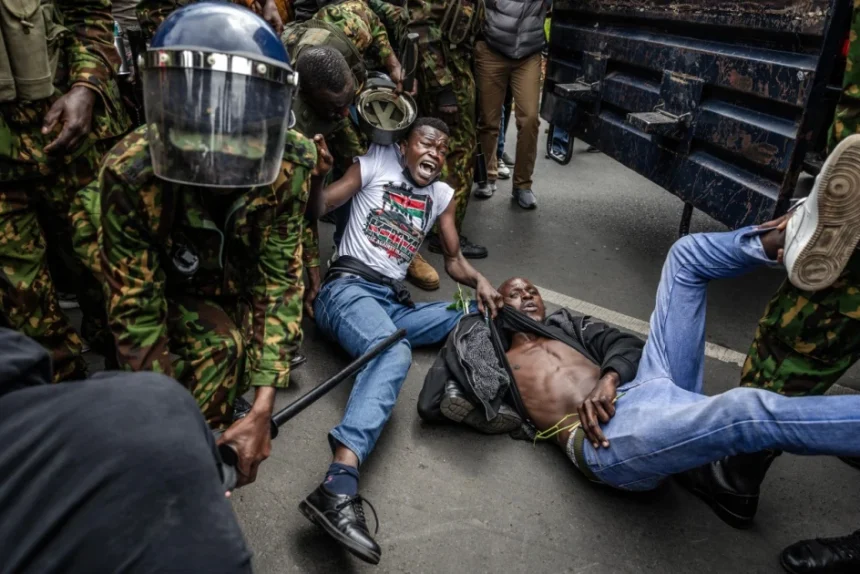
When Interior Cabinet Secretary Kipchumba Murkomen took the podium at Harambee House on Thursday evening, the country braced for a hardline, adversarial briefing. The capital had just endured a day of heavy highway checkpoints, transport gridlocks, and pockets of running battles in the Central Business District.
The Star
Yet, the core message delivered by the Interior Ministry surprised both political analysts and civil society organizers. Instead of issuing a blanket condemnation of the demonstrations, Murkomen explicitly praised the overall day as a historic marker of Kenya’s growing “political maturity.” Even while confirming a nationwide total of 355 arrests, the state’s strategic framing focused on a new narrative: proving that constitutional dissent can actively co-exist with public order when security agencies and citizens follow the law.
Dawan Africa
The Strategic Narrative: Separating Grief from Crime
The primary objective of Murkomen’s address was to clearly separate peaceful commemorative groups from opportunistic criminal networks.
Capital FM
Unlike previous civic unrest windows marked by heavy political polarization, the Interior Ministry openly acknowledged the legitimacy of the day. The state noted that families and friends of those who lost their lives in previous cycles of anti-tax demonstrations were able to hold solemn, peaceful memorial processions in several parts of the country without state interference.
Dawan Africa
+ 1
[ THE HARD-LINE ADMINISTRATIVE SPLIT ]
│
┌───────────────────────────┴───────────────────────────┐
▼ ▼
[ The Commemorative Marches ] [ The Criminal Infiltration ]
• Guided by families of victims • Opportunistic networks targeted shops
• Exercised constitutional rights • Attempted vandalism & road blocks
• Handled with police restraint • Met with swift 355-arrest dragnet
The 355 arrests, Murkomen maintained, were purely a tactical enforcement response targeting a small minority trying to exploit the anniversary. By defining the suspects explicitly as common offenders facing charges of robbery, road obstruction, intentional vandalism, and attempted theft, the state protected the peaceful integrity of the wider Gen Z movement while justifying its hardline policing actions.
Capital FM
+ 1
The Intelligence Ledger: Defending the Pre-Emptive Blockade
The briefing offered an look into the decision-making pipeline that led to the early morning lockdown of Thika Superhighway, Waiyaki Way, and Mombasa Road.
Addressing widespread public anger regarding commuters being forced to walk long distances due to early morning police checkpoints, Murkomen revealed that the operation was completely intelligence-driven. The ministry had received verifiable reports that political actors and criminal networks intended to ferry hired goons into the capital to commit mass looting.
Dawan Africa
“We regret the inconvenience caused to the public,” Murkomen noted. “But today’s events prove that when demonstrations are conducted in accordance with our Constitution, peace is guaranteed. This is the democratic culture we must promote.”
Geographic Breakdown of the Enforcement Dragnet:
The localized arrest numbers reflect exactly where security machinery intercepted these suspected disruptions before they could consolidate in the city center:
Nairobi County: 161 arrests (primarily around CBD perimeter gates and University Way).
The Star
Kajiado County: 123 arrests (heavy pre-emptive sweeps in Kitengela and Rongai).
KenyaMOJA.com
Kiambu County: 36 arrests (targeting transit convergence points).
Capital FM
Rural Basins: Murang’a (12), Bungoma (9), Meru (6), Laikipia (5), and Machakos (3).
The Star
The Only Major Casualty: The Murang’a Incident
To back up the state’s claim that police operated with high levels of operational restraint, Murkomen pointed out that no civilian deaths or widespread protest-related injuries were recorded nationwide.
Capital FM
The only major physical casualty reported by the state involved an administrative officer in Murang’a County. Anthony Gathungu, the Assistant Chief of Kariti Sub-location in Kandara, was seriously assaulted by an aggressive group attempting to block a primary transit lane with heavy boulders. The administrator was rushed to Kagunduini Health Centre, treated for his injuries, and discharged in stable condition.
Capital FM
+ 2
Setting a Precedent for Future Civics
By framing the day as an administrative success, the Ministry of Interior is trying to establish a new blueprint for managing civic friction in Kenya. The underlying message to the public is clear: the state will accommodate peace, remembrance, and open criticism of policies like the Finance Bill 2026—but the infrastructure of the capital remains completely non-negotiable.
As the 355 suspects prepare to face regional magistrates on Friday morning, the focus shifts to the judiciary to see if this new narrative of structured legal accountability holds up inside the courtroom.