

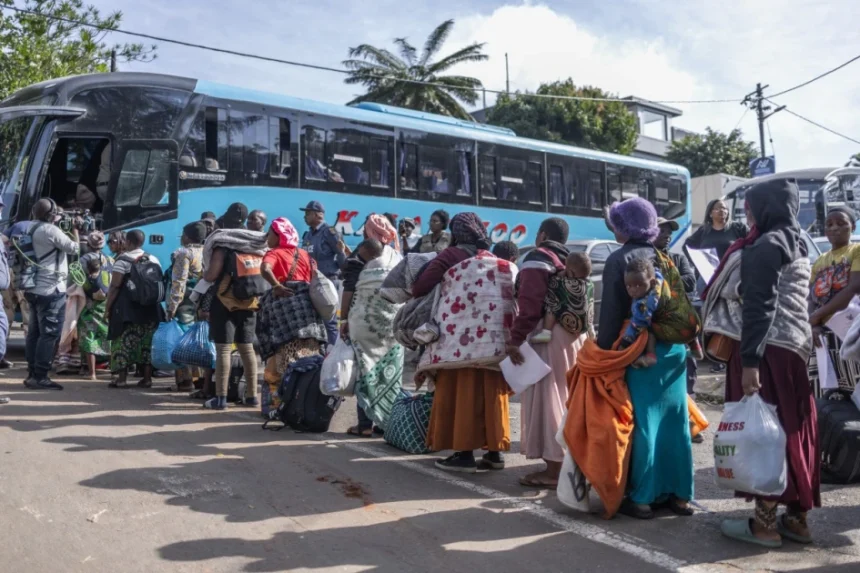
South Africa has launched an aggressive, state-led immigration sweep that signals a major shift toward hardline border enforcement. The Department of Home Affairs confirmed that 2,745 foreign nationals were repatriated in a single week, marking one of the most intense, concentrated deportation operations in the country’s recent history.
NAMPA
The mass repatriations follow an explicit directive from President Cyril Ramaphosa, who recently vowed to take uncompromising action against undocumented immigration.
NAMPA
As immigration enforcement teams and police units step up raids across commercial and residential hubs, the sudden surge in deportations highlights the intense political pressure on the government to stabilize a volatile domestic labor market.
The Catalyst: Political Vows Meet a Volatile Deadline
The timing of this sweep is far from accidental. The sudden rise in state-led deportations occurs amidst severe, localized social tensions and organized anti-immigrant mobilization.
GroundUp
THE SOUTH AFRICAN IMMIGRATION CRITICAL PRESSURE
[Presidential Directive] ──► Law enforcement orders massive sweeps.
│
┌──────────────────────────────────────┴──────────────────────────────────────┐
▼ ▼
[CIVIC DEADLINES & DISINFO] [THE MACROECONOMIC REALITY]
Anti-illegal immigration groups set a A persistent unemployment rate
June 30 ultimatum; fake notices trigger panic. above 30% drives severe anti-migrant friction.
The government’s crackdown is unfolding against a complex backdrop of civic unrest and online misinformation:
The Vigilante Ultimatum: Grassroots anti-immigration movements, including the prominent “March and March” civic group, have publicly issued a June 30, 2026 deadline demanding that undocumented migrants leave the country voluntarily, even threatening a total national shutdown if the state fails to act.
Martin Plaut
The Fake Notices: The tension has been heavily amplified by viral disinformation campaigns. The South African Police Service (SAPS) recently had to issue a high-alert warning to debunk a fraudulent Department of Home Affairs poster circulating on TikTok and Facebook that claimed all illegal foreigners faced immediate arrest if they didn’t leave by month’s end.
Africa Check
+ 1
By executing 2,745 deportations in seven days, the state is attempting to demonstrate absolute authority, signaling to vigilante syndicates and worried local communities that the official justice system—not street-level groups—controls national borders.
NAMPA
Socio-Economic Drivers: The 30% Unemployment Squeeze
South Africa boasts one of the most advanced and diversified economies on the African continent, making it a powerful magnet for both skilled and undocumented migrant workers fleeing economic stagnation or conflict in neighboring states.
NAMPA
However, the domestic economy is facing its own internal limitations, turning immigration into a major political battleground.
The Labor Mismatch: With a national unemployment rate stubbornly locked above 30 percent, local working-class populations increasingly view foreign nationals as direct competitors for scarce low-skilled jobs in agriculture, construction, retail, and informal trade. Human rights organizations note that this economic squeeze regularly sparks dangerous waves of anti-immigrant unrest and structural scapegoating in major urban centers like Johannesburg, Durban, and Pretoria.
NAMPA
The Geopolitical Fallout: Regional Partners React
The intensity of the ongoing operations is creating significant diplomatic friction across the Southern African Development Community (SADC) and the wider African Union (AU).
Region Immigration Metrics Weekly Repatriation Tally Primary Domestic Target Areas Regional Diplomatic Status
South Africa 2,745 Foreign Nationals Industrial job sites, informal retail blocks, residential sweeps Tense; regional governments monitor citizen welfare
As enforcement teams continue their sweep, neighboring countries are actively preparing for the fallout. In past cycles, aggressive immigration operations and localized threats have forced nations like Ghana, Nigeria, Malawi, and Mozambique to orchestrate emergency evacuations to fly their citizens out of South African cities safely.
With the unofficial June 30 civilian deadline approaching, foreign ministries across the continent are keeping a close watch on Pretoria, urging the South African government to guarantee that its mass deportation strategy complies fully with international humanitarian laws and the African Continental Free Trade Area (AfCFTA) protocols.
Conclusion: Will Hardline Sweeps Prevent Future Friction?
The removal of nearly 2,750 people in a week proves that South Africa’s Home Affairs ministry is serious about enforcing its immigration laws. By scaling up formal state operations, President Ramaphosa’s administration hopes to ease public anger and reduce the risk of community-level violence.
However, migration experts argue that deportations alone cannot solve the crisis. As long as neighboring economies face instability and South Africa’s domestic unemployment remains high, the pressure on the country’s borders will persist. True long-term stability will require a balanced approach that pairs strict, legal border management with comprehensive economic reforms across the region.
Related Regional News Analysis
To see a deeper dive into how anti-immigration groups are mobilizing across different provinces and how local migrant communities are reacting to the impending deadlines, watch this CGTN Africa News Report on South Africa’s Immigration Tensions. This broadcast provides crucial regional context on the standoff between civic protesters, foreign nationals, and the state security apparatus.
South African anti-immigration group threatens national shutdown – YouTube
CGTN Africa · 7.4K views