
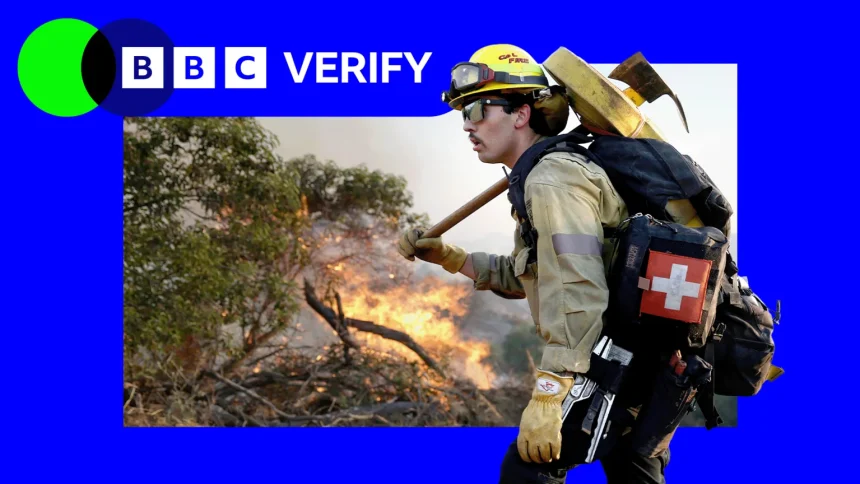
When a major blaze breaks out in the rugged backcountry of California—such as the fast-moving Santa Rosa Island fire or sudden brush ignitions in Kern County—ground teams face an immediate, life-or-death question: Which way is the fire front moving, and how fast?
Thick, blinding blankets of smoke make traditional aerial scouting planes useless, leaving incident commanders blind. To pierce the haze, modern emergency management relies entirely on an orbital shield. The rapid evolution of California wildfire tracking satellite technology has transformed space assets from historical imaging tools into active, tactical command systems.
By leveraging specialized light spectrums, geostationary sentinels, and cutting-edge artificial intelligence, scientists can map uncontained fire lines through solid walls of smoke. Here is the engineering breakdown of how space technology manages the frontlines.
Shortwave and Thermal Infrared: Piercing the Smoke Veil
To a standard camera or the human eye, an active wildfire zone looks like an opaque cloud of gray and black ash. For satellites, however, smoke is essentially transparent—provided you look at the landscape through the correct wavelength of light.
[The Spectrum Advantage]
Visible Light Spectrum ──────► Blocked entirely by smoke particles and ash clouds.
Shortwave Infrared (SWIR) ───► Pierces smoke to capture intense heat signatures on the ground.
Orbital platforms like the joint NASA/NOAA VIIRS (Visible Infrared Imaging Radiometer Suite) instrument capture data across multiple spectral bands simultaneously. While the visible light band maps the path of the outer smoke plume, the Shortwave Infrared (SWIR) and Thermal Infrared bands cut straight through the airborne particulate matter.
These infrared sensors register the intense thermal radiation emitted by burning vegetation. Because SWIR wavelengths are much larger than smoke particles, the light passes through the cloud unobstructed. This allows orbiters to map exactly where the most intense heat anomalies are concentrated, providing ground crews with precise coordinates of the active fire perimeter.
Geostationary vs. Polar-Orbiting Sentinels: The Tactical Balance
No single satellite can handle the tracking process alone. Fire management relies on a carefully balanced team of two entirely different types of orbital networks:
1. Geostationary Sentinels (The Constant Watch)
Positioned roughly 22,200 miles directly above the equator, NOAA’s GOES-West satellite matches the rotation of the Earth perfectly. Because it hovers over the exact same patch of the Western United States constantly, it acts as a real-time surveillance camera. GOES-West scans the entire California landscape every 5 minutes, allowing algorithm-driven alert systems to flag sudden, early-stage ignitions in remote canyons before a single 911 call is placed.
2. Polar Orbiters (The High-Resolution Microscope)
While geostationary satellites provide unmatched speed, their extreme distance limits their visual detail. That is where low-Earth orbiters like Suomi NPP, NOAA-20, and NOAA-21 come in. Tracing a path from pole to pole just a few hundred miles up, these satellites pass over California twice a day.
Sensor System Orbit Altitude Spatial Resolution Core Fire Advantage
GOES-West (ABI) ~22,200 miles 2 km pixels Continuous, 5-minute refreshes for instant alerts
VIIRS (Suomi NPP/NOAA) ~512 miles 375-meter pixels Sharp, high-resolution edge mapping through smoke
Landsat 8 & 9 (OLI) ~438 miles 30-meter pixels Precise, micro-level burn scar and fuel moisture mapping
The 2026 Pipeline: NASA FIRMS and the Rise of AI Integration
Gathering raw data in orbit is meaningless if it takes hours to process. In the high-stakes environment of emergency management, a 3-hour delay means the information is already obsolete.
To close this window, platforms like NASA’s Fire Information for Resource Management System (FIRMS) rapidly process raw satellite data feeds, converting thermal anomalies into downloadable mapping layers within three hours of a satellite pass. For U.S. incidents, select real-time data pipelines drop that latency down to minutes.
[Satellite Data Pipeline]
Satellite Sensor Pass ──► Ground Station Downlink ──► AI Grid Analysis ──► Incident Commander Dashboard (Minutes)
The major breakthrough comes from the integration of Artificial Intelligence and predictive machine learning platforms. Modern systems combine real-time VIIRS and MODIS thermal detections with automated tower-mounted webcams, regional wind vectors, and historic live-fuel moisture levels.
Rather than just displaying where a fire is, these AI engines calculate localized atmospheric conditions to predict where the fire front will expand over the next 60 minutes. This gives Cal FIRE and federal agencies a critical head start for ordering targeted evacuations and positioning structural defense lines.
Mapping the Fuel Bed Before the Spark
The most critical phase of modern satellite tracking actually happens before a single spark hits dry grass. Instruments mounted on the International Space Station, such as ECOSTRESS (Ecosystem Spaceborne Thermal Radiometer Experiment on Space Station), measure the temperature of the plant canopy below.
By monitoring subtle shifts in plant temperatures, scientists can accurately calculate vegetation water stress. When a forest is severely dehydrated, its canopy heats up. This data creates highly detailed “fuel vulnerability maps” weeks in advance, showing fire crews exactly which ridges and valleys are primed for explosive fire behavior if an ignition occurs.
Space-based technology has fundamentally changed the rules of engagement for wildfire suppression. By turning the sky into an intelligent, multi-spectral eye, remote sensing ensures that even when a blaze is completely uncontained on the ground, it can never truly hide.
To look deeper into remote sensing technology:
Analyze how Synthetic Aperture Radar detects post-fire mudslide risks
Explore the development of dedicated wildfire smallsat constellations