

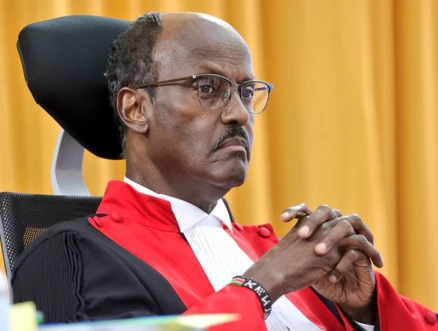
Kenya’s legal landscape was shaken today by the somber news: Supreme Court Judge Ibrahim Mohammed has died. The confirmation from the Judiciary sends waves of mourning across the nation, from the hallowed halls of the Supreme Court in Nairobi to the chambers of lawyers nationwide. Justice Mohammed was not merely a judge; he was a steadfast guardian of Kenya’s constitutional order, whose sharp intellect and unwavering principles shaped landmark rulings. As Kenyans come to terms with this significant loss, we reflect on the journey, contributions, and profound legacy of Justice Mohammed—a man whose work defended the very fabric of our democracy.
Section 1: The Journey to the Apex Court
Justice Mohammed’s path to becoming one of Kenya’s most respected legal minds was paved with diligence and an unyielding commitment to justice.
Humble Beginnings: Born in [County, if known], his pursuit of law began at [University, if known]. He was called to the Bar in [Year] and cut his teeth in private practice, earning respect for his meticulous approach.
Rising Through the Ranks: His judicial career began as a Magistrate, where his fairness and legal acumen were quickly noted. He served with distinction as a High Court Judge, presiding over complex civil and constitutional matters, before his elevation to the Court of Appeal.
The Pinnacle Appointment: In [Year], after a competitive process by the Judicial Service Commission (JSC), he was sworn in as a Judge of the Supreme Court of Kenya. His appointment was celebrated as a triumph for merit and a strengthening of the apex court’s intellectual depth.
Section 2: The Jurist’s Signature: Key Decisions That Shaped Kenya
Justice Mohammed’s jurisprudence was characterized by a clear-eyed commitment to the letter and spirit of the Constitution. His voice was crucial in several pivotal cases:
Upholding Electoral Sovereignty: He was part of the unanimous Supreme Court bench that made the historic decision to nullify the presidential election in September 2017, a ruling that underscored the judiciary’s independence and redefined electoral justice in Africa.
Championing Devolution: In disputes between county governments and the national treasury, his opinions often reinforced the principles of cooperative governance and equitable resource sharing, strengthening the devolved system.
Protecting Civil Liberties: In cases touching on the Bill of Rights, Justice Mohammed was a vocal defender of freedoms of expression and assembly, often cautioning against the overreach of state power.
Section 3: Personal Tributes and the Weight of Loss
Beyond the judgments and legal texts, Justice Mohammed was remembered as a man of character.
From Chief Justice Martha Koome: “The judiciary has lost a brilliant mind and a virtuous soul. Justice Mohammed was a reservoir of wisdom whose humility and dedication to duty were an inspiration to us all. Our prayers are with his family.”
From the Law Society of Kenya (LSK): “He was a judge who listened. His courtroom was a place where legal argument was respected, and his judgments were always reasoned, never personal. The Bar has lost a true friend.”
A Quiet Family Man: Colleagues speak of a man deeply devoted to his family, who valued his private life. His passing leaves an immeasurable void in their lives, and the nation shares in their grief.
Section 4: Navigating the Future: Filling the Vacancy
The death of a Supreme Court judge triggers a critical constitutional process to ensure the stability of the nation’s highest court.
Constitutional Mandate: Article 166 of the Constitution guides the replacement. The President will appoint a new judge, acting on the recommendation of the JSC.
The JSC Process: Expect a public call for applications, followed by transparent interviews broadcast to the nation. The JSC’s choice will be scrutinized for competence, integrity, and independence.
Why It Matters: This appointment comes at a critical time. The Supreme Court’s composition directly impacts its direction on key issues affecting Kenya’s future, from governance to human rights.
Conclusion: An Enduring Pillar of Justice
The announcement that Supreme Court Judge Ibrahim Mohammed has died marks the end of a consequential chapter in Kenya’s judicial history. In an era where institutions are constantly tested, Justice Mohammed stood as a reminder that integrity and intellectual courage are the cornerstones of public trust. His legacy is etched not in stone, but in the strengthened rule of law and the precedent that power must always be exercised within constitutional bounds. As the judiciary and the nation mourn, his life’s work challenges every legal professional and public servant to uphold the high standards he embodie