
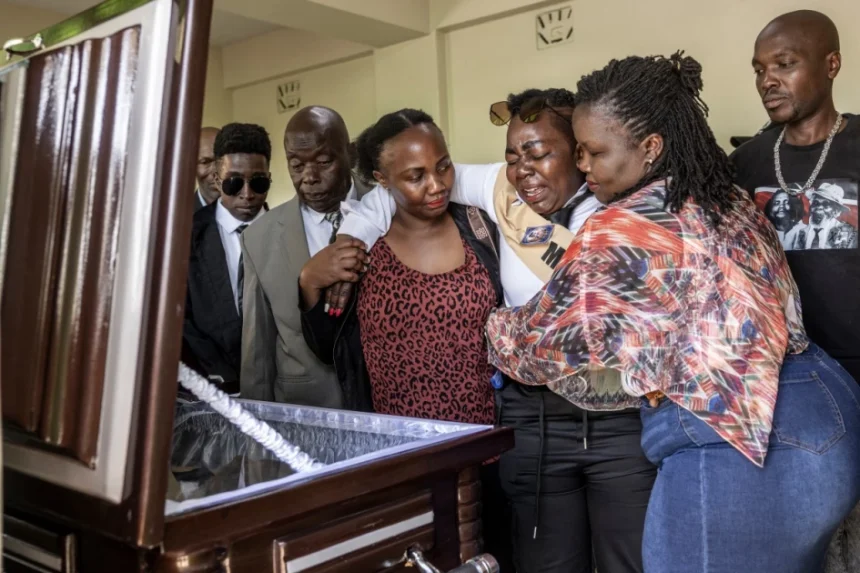
The story of Christopher Njora Muronyo is the story of the Mau Mau movement itself: a fierce, desperate struggle followed by decades of systematic neglect. On February 14, 2026, as hundreds gathered in Nyandarua to say goodbye, the atmosphere was thick with more than just grief—it was heavy with a sense of profound betrayal.
1. A Life Defined by Resistance
General Kiambati was a direct link to the inner circle of Field Marshal Dedan Kimathi, the spiritual and military heart of the Mau Mau rebellion. Taking up arms in 1952, Kiambati lived the life of a guerrilla in the freezing forests of the Aberdares, surviving on wild honey and roots while dodging the “Manhunt” of British colonial forces.
He was one of the few who saw Kimathi captured in 1956. While his leader was executed by the British in 1957, Kiambati survived—barely. He carried the scars of battle literally to his grave; the three bullets in his body were never removed because the veteran could never afford the specialized medical care required.
2. The “Forgotten” Funeral
Perhaps the most stinging aspect of the February 2026 burial was what was missing.
No State Recognition: Despite being one of the last high-ranking leaders of the independence struggle, no high-level government dignitaries attended the funeral.
Poverty at the End: His daughter, Emily Kiambati, spoke with raw bitterness, revealing that her father died in “abject poverty.” The family had to rely on well-wishers and donations just to host a modest send-off.
The Pauper Hero: While Kenya’s current elite drive through Nairobi in armored SUVs, the man who fought to liberate the land lived his final days in a mud-walled shack.
“He was a hero, but today I am not celebrating. The national government did nothing for him while he breathed, and they do nothing for him now that he is gone.” — Emily Kiambati, February 14, 2026.
3. The Betrayal Narrative: Why the Silence?
To understand why a hero like General Kiambati died a pauper, one must understand the political history of post-independence Kenya.
The Kenyatta Era: After 1963, the first administration of Jomo Kenyatta marginalized the Mau Mau to avoid “scaring the West” and to maintain stability among those who had collaborated with the British (the “Home Guards”).
Outlawed for Decades: Unbelievably, the Mau Mau remained a proscribed (illegal) terrorist organization until the ban was finally lifted in 2003.
The Compensation Gap: While a 2013 settlement from the British government provided some funds to roughly 5,000 veterans who could prove torture, thousands more—like General Kiambati—fell through the cracks of documentation and legal bureaucracy.