

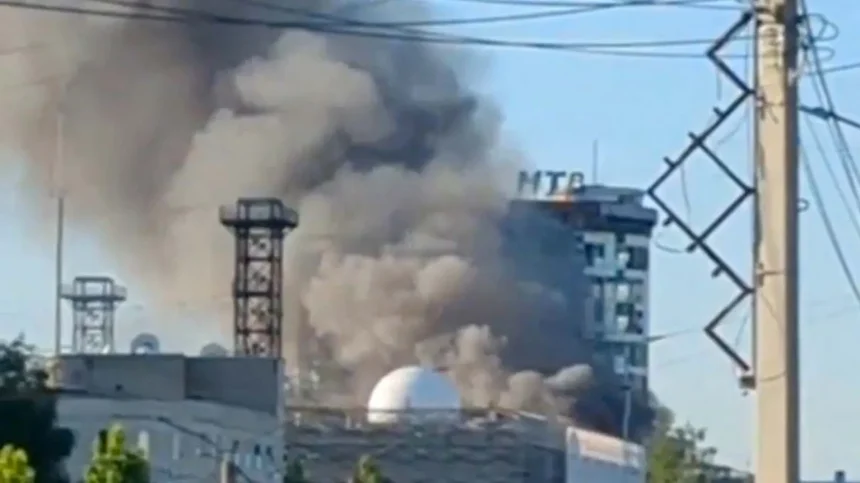
The fifth year of the Russia-Ukraine conflict has shifted from a stagnant war of attrition along a fixed frontline into a high-stakes, asymmetric deep-strike campaign. In one of its most audacious and technologically advanced operations to date, Ukrainian forces launched a coordinated wave of long-range attacks targeting critical military industries and energy infrastructure thousands of kilometers behind Russian lines.
CityNews Halifax
+ 1
On Wednesday, June 10, 2026, Ukrainian President Volodymyr Zelenskyy confirmed that domestically developed cruise missiles successfully penetrated Russia’s layered air defense networks, striking a high-value military electronic facility in the city of Cheboksary. The strike marks a turning point in Kyiv’s strategic doctrine: instead of merely managing the consequences of incoming aerial bombardments, Ukraine is systematically neutralizing the industrial supply chains that make those attacks possible.
The Kyiv Independent
+ 1
This deep-dive investigative analysis breaks down the anatomy of the June 10 strike, the capabilities of Ukraine’s new homegrown missile system, the unique strategic value of the targeted facility, and how this evolving campaign reshapes the geopolitics of the region.
The Multi-Front June 10 Strike Campaign
The attack on Cheboksary was not an isolated event; it formed the crown jewel of a sprawling, synchronized multi-front offensive orchestrated by the Missile Forces of the Ukrainian Ground Forces and Special Forces units of the Security Service of Ukraine (SBU).
The Kyiv Independent
By hitting electronic plants, oil processing hubs, and logistical vessels simultaneously, Ukraine forced a massive strain on Russian early-warning and interception systems.
YouTube
Target Facility Location / Region Distance from Frontline Operational & Economic Impact
VNIIR-Progress Plant Cheboksary, Chuvash Republic ~1,000 Kilometers Destruction of primary manufacturing line for anti-jamming satellite antennas.
Kuibyshev Oil Refinery Samara Oblast ~900 Kilometers Fires triggered at a hub processing 3.7 million tons of crude oil annually for military use.
Vtorovo & Lobkovo Stations Vladimir Oblast ~700 Kilometers Disruption of diesel fuel pipelines supplying the Moscow Ring and export ports.
Shadow Fleet Tanker West Horizon Black Sea Maritime Zone Maritime Structural damage to steering and propulsion systems used to evade oil sanctions.
Crimean Panorama Building Sevastopol, Occupied Crimea Immediate Frontline Historic 19th-century cultural infrastructure housing the Franz Rubo panorama destroyed.
Anatomy of the Strike: The VNIIR-Progress Bottleneck
By the early hours of Wednesday morning, geolocated footage and open-source intelligence networks lit up with videos of a low-flying, highly agile projectile whistling over the skyline of Cheboksary, located in Russia’s Chuvash Republic. Moments later, a massive explosion rocked the industrial compound of the VNIIR-Progress defense electronics plant, sending a dense plume of black smoke visible across the city.
UNITED24 Media
+ 1
For outside observers, Cheboksary may seem like an obscure target. For Ukrainian military planners, however, it represents a critical vulnerability in Russia’s advanced weapons manufacturing sector.
UNITED24 Media
Why VNIIR-Progress is a High-Priority Target
VNIIR-Progress is part of the specialized ABS Electro industrial group and functions as Russia’s premier facility for producing satellite navigation receivers and precision antenna arrays compatible with GLONASS, GPS, and Galileo networks.
UNITED24 Media
Most importantly, the plant is the sole manufacturer of the “Kometa” antenna module.
[VNIIR-Progress Plant] ──> Kometa Anti-Jamming Modules ──> Shahed Drones & Iskander Missiles ──> Frontline Penetration
The Kometa module is the exact electronic component that allows Russian Shahed-type suicide drones, Iskander-M ballistic missiles, Kalibr cruise missiles, and heavy guided aerial glide bombs to resist Western-supplied electronic warfare (EW) jamming and spoofing systems. Without these advanced anti-jamming antennas, Russian precision weapons become highly susceptible to GPS-disruption networks, making them significantly easier for Ukrainian air defenses to intercept before reaching civilian centers.
Kyiv Post
+ 1
The Weapon of Choice: The FP-5 ‘Flamingo’ Cruise Missile
The Cheboksary operation has solidified the operational deployment of Ukraine’s premier long-range asset: the FP-5 “Flamingo” cruise missile. Developed entirely within the domestic private sector by the defense innovator FirePoint, the Flamingo highlights Ukraine’s rapid evolution from a recipient of foreign military aid into an independent exporter of top-tier defense tech.
UNITED24 Media
+ 1
“Our units are executing operations that were structurally impossible just two years ago,” noted a representative from Ukraine’s General Staff. “The Flamingo allows us to hold high-value assets inside the Russian interior at risk without relying on Western permissions or launch parameters.”
UNITED24 Media
Technical Specifications of the FP-5 Flamingo
While many technical details remain highly classified, open-source documentation reveals a formidable system designed specifically to bypass modern radar arrays:
Operational Range: Capable of executing precise strikes at distances ranging from 1,000 km up to an estimated maximum of 3,000 kilometers, putting the entirety of European Russia within operational reach.
UNITED24 Media
Flight Profile: Utilizes ultra-low-altitude terrain-following flight paths to slip underneath standard Russian radar cross-sections.
Guidance Architecture: Integrated with multi-spectral optical terminal homing and advanced internal guidance systems, allowing it to hit specific workshop structures even when subjected to intense localized electronic jamming.
Collateral Damage and Choking the Kremlin’s Energy Grid
While the primary blow struck Russia’s military tech architecture, the secondary phases of the June 10 offensive targeted the economic fuel powering the Russian military machine.
In the Samara region, SBU drone swarms successfully breached the perimeter defenses of the Kuibyshev oil refinery. The resulting impact ignited a massive blaze across primary processing units. This specific refinery is deeply tied to Russia’s military logistics, providing refined fuels, lubricants, and specialized propellants directly to the armed forces operating in the southern and eastern theaters.
The Moscow Times
Simultaneously, Alpha Special Forces units targeted the Vtorovo and Lobkovo oil pumping stations in the Vladimir region. Satellite thermal monitoring systems monitored by NASA’s FIRMS network detected major thermal anomalies at both sites, indicating severe infrastructure fires. Because these pumping stations feed directly into the Moscow Ring Oil Product Pipeline, the structural damage is expected to trigger immediate localized fuel supply bottlenecks across the capital region.
The Kyiv Independent
+ 2
[Vladimir Pumping Stations] ──> Pipeline Disruption ──> Moscow Ring Supply Bottlenecks ──> Regional Fuel Scarcity
The Destruction of the Sevastopol Panorama
The multi-pronged escalation also brought tragic cultural casualties. In Russian-occupied Sevastopol, a Ukrainian drone strike targeted local military command elements but inadvertently impacted the historic building housing the world-famous “Defense of Sevastopol 1854–1855” panorama painting.
The Washington Post
The colossal artwork, crafted by legendary panoramic artist Franz Rubo to depict the 19th-century Crimean War, was reported as completely destroyed by local authorities. The incident highlights the brutal reality of modern drone warfare, where high-density military assets embedded within historical cities place priceless cultural heritage at extreme risk.
The Washington Post
Geopolitical Shifts: Challenging the Kremlin’s Narrative
The sheer depth and regularity of these long-range operations pose a severe political challenge to Russian President Vladimir Putin. For years, the Kremlin has maintained a public narrative that the war remains far removed from the daily lives of ordinary Russian citizens and that domestic air defenses are entirely impenetrable.
However, coming directly on the heels of previous strikes against the St. Petersburg Oil Terminal and the pruning of the annual Victory Day parade due to drone anxieties, the June 10 strikes dismantle that facade. When air raid alerts are actively sounding 1,000 kilometers deep into the Russian interior, the domestic cost of the ongoing campaign becomes impossible for state media to conceal.
As Ukraine secures fresh commitments for advanced air defense munitions from recent diplomatic summits in London and Tallinn, the focus continues to look toward self-sufficiency. By utilizing tools like the FP-5 Flamingo to destroy the manufacturing bottlenecks behind Russia’s missile and drone arrays, Kyiv is actively shifting the baseline of regional deterrence, proving that in the theater of modern conflict, no rear sanctuary is truly untouchable.
AP News
+ 1