
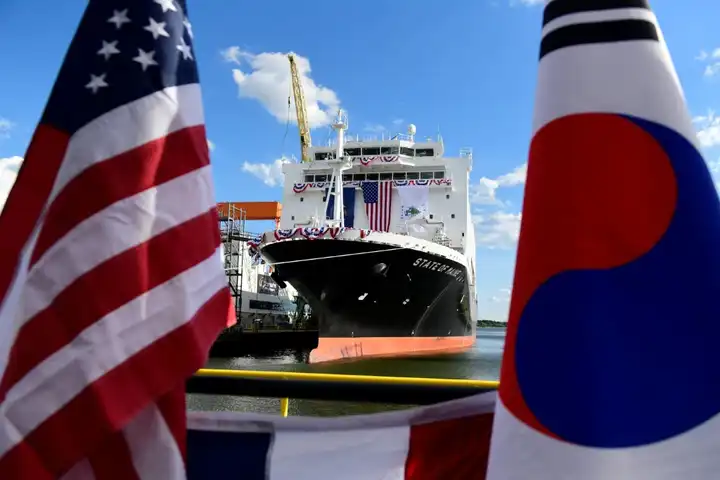
Beijing, China — In a move that has caught the attention of global investors and diplomats alike, China has lifted sanctions on US-based subsidiaries of South Korea’s Hanwha Group, one of Asia’s largest defense and shipbuilding conglomerates.
The decision, announced through China’s Ministry of Commerce on Friday, is being interpreted as a signal of de-escalation amid ongoing geopolitical tensions between Beijing, Seoul, and Washington. It also marks a potential turning point for regional trade cooperation, which has faced years of strain due to security and defense disputes.
Background: How the Sanctions Began
The restrictions on Hanwha’s US subsidiaries date back to the height of diplomatic friction following South Korea’s 2017 deployment of the US-made THAAD missile defense system, which China strongly opposed.
At the time, Beijing viewed the deployment as a security threat and imposed unofficial economic measures on several South Korean companies, including travel bans, reduced trade licenses, and restrictions on Chinese partnerships.
Although many of these restrictions have been gradually eased, Hanwha’s defense-linked operations remained under scrutiny — until now.
“China’s decision to remove sanctions on Hanwha is a major development in rebuilding trust with South Korea,” said Dr. Park Hyun-soo, an analyst at the Seoul Institute for International Relations.
“It suggests Beijing is seeking to improve its image and economic ties amid a slowing domestic economy.”
Why the Move Matters Now
The lifting of sanctions comes at a crucial moment as China faces slowing growth, South Korea seeks to diversify export markets, and the United States continues to reshape global trade alliances.
Hanwha Group, known for its expansive portfolio spanning defense, shipbuilding, renewable energy, and aerospace, has recently been deepening its presence in the US and Middle East, providing advanced naval systems and green energy solutions.
Analysts say that lifting the sanctions will allow Hanwha’s American subsidiaries — particularly Hanwha Ocean (formerly Daewoo Shipbuilding) and Hanwha Aerospace USA — to freely engage in projects involving Chinese suppliers, technology imports, and logistics networks.
“This move indicates China’s willingness to balance its political interests with practical economic cooperation,” noted Prof. Li Jian of Beijing Foreign Studies University.
“Both sides stand to gain from stability in supply chains, especially in the shipbuilding and energy sectors.”
Trade and Diplomacy: A Delicate Balancing Act
The timing of the announcement coincides with a period of intense diplomatic recalibration in East Asia. Beijing has recently sought to mend ties with several US allies, including South Korea and Japan, amid fears of economic isolation as Western countries diversify manufacturing away from China.
For Seoul, the move is also politically significant. The Yoon Suk Yeol administration has maintained a delicate balance — cooperating closely with Washington on security while keeping communication lines open with Beijing on trade and investment.
“It’s a positive development that shows diplomacy still works,” said Choi Sang-won, a Seoul-based policy researcher.
“If managed carefully, this could open the door for joint industrial projects between Chinese and Korean companies again.”
Economic Impact and Market Reactions
Following the news, Hanwha Group’s shares rose 2.3% on the Seoul stock exchange, reflecting investor optimism about the group’s prospects in China and other Asian markets.
Financial analysts predict that the decision could unlock new export opportunities for Hanwha Ocean, particularly in shipbuilding contracts involving Chinese steel and electronics components.
Moreover, it could improve regional cooperation in renewable energy and defense technology, sectors where Hanwha is rapidly expanding its global footprint.
“This announcement may seem symbolic, but it carries real economic implications,” explained Samuel Kim, a trade economist at the Korea Development Institute.
“The easing of restrictions allows companies like Hanwha to operate more efficiently in Asia’s complex supply chain ecosystem.”
A Strategic Message to Washington?
While the decision benefits South Korea economically, it also carries strategic weight for China’s relationship with the United States.
By lifting sanctions on US-based subsidiaries of a South Korean firm, Beijing appears to be signaling openness — not confrontation — in its dealings with global business networks.
Some analysts view the move as part of China’s broader effort to project moderation ahead of upcoming trade talks with the US, while also countering the narrative that its economic policies are overly punitive.
“This is China’s way of saying it wants dialogue, not escalation,” said Dr. Margaret Liu, an expert on Asian geopolitics.
“It’s a soft-power gesture that aligns with Beijing’s current diplomatic strategy of selective engagement.”
Hanwha’s Response
In a brief statement, Hanwha Group welcomed China’s decision, emphasizing that the company remains committed to building transparent and cooperative relationships in all markets.
“We appreciate the spirit of dialogue and cooperation that led to this outcome,” the statement read.
“Hanwha will continue to contribute to global economic growth through innovation and partnership.”
The company did not comment on whether it plans to immediately resume any halted operations involving Chinese partners.
The Bigger Picture: Trade Thaw or Temporary Gesture?
Experts caution that while the lifting of sanctions marks progress, it does not necessarily signal a full normalization of China–South Korea trade relations.
The two countries continue to differ on security, technology exports, and alliance politics, particularly regarding Seoul’s role in US-led semiconductor and defense initiatives.
Nonetheless, the Hanwha decision could pave the way for broader economic engagement, especially in the private sector where mutual benefits outweigh political tensions.
“China needs stable partners for its supply chains, and South Korea needs access to Chinese markets,” said Dr. Eun Lee, a trade scholar at Yonsei University.
“This move could be the beginning of a slow, cautious rapprochement.”
Conclusion: A Step Toward Stability in Asian Trade
China’s decision to lift sanctions on Hanwha’s US units sends a powerful message of pragmatism and cooperation at a time when global trade faces unprecedented challenges.
For South Korea, it offers renewed opportunities for business and diplomacy. For the region, it signals that economic interests — when prioritized — can still bridge deep political divides.
Whether this marks a lasting thaw or a strategic pause remains to be seen. But for now, both sides seem ready to turn a page toward stability and partnership in Asia’s evolving trade landscape.