

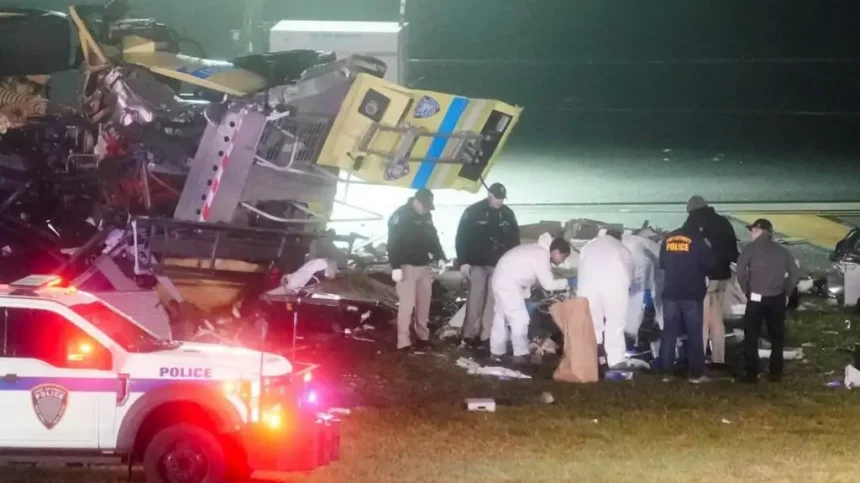
New York’s LaGuardia Airport (LGA) remains at a standstill today, Monday, March 23, 2026, following a catastrophic runway collision late Sunday night. What was meant to be a routine landing for Air Canada Express Flight 8646 from Montreal turned into a scene of devastation when the regional jet struck a Port Authority fire truck at high speed.
The Port Authority of New York and New Jersey has confirmed the deaths of both the pilot and co-pilot. The impact, which occurred at approximately 11:40 PM ET, crushed the cockpit of the Bombardier CRJ-900, leaving the aircraft’s nose mangled and tilted toward the sky.
The Sequence of Events: “Stop, Truck 1. Stop!”
Preliminary reports and leaked Air Traffic Control (ATC) audio from LiveATC.net paint a harrowing picture of the moments leading up to the crash.
The fire truck, designated “Truck 1,” was reportedly responding to a separate emergency—a United Airlines flight that had reported an “issue with an odor” on board. As the emergency vehicle attempted to cross Runway 4 to reach the United jet, the Air Canada flight was already in its final seconds of landing.
The Clearance: Audio indicates that a controller initially gave the fire truck clearance to cross the tarmac.
The Panic: Seconds later, the same controller realized the imminent danger. He is heard frantically repeating, “Stop, stop, stop! Truck 1, stop!” * The Impact: It was too late. The CRJ-900, operated by Air Canada’s regional partner Jazz Aviation, struck the vehicle at an estimated speed of 24 mph (39 km/h) during its rollout. The force of the collision caused the fire truck to tip onto its side.
Casualties and Survival: A Narrow Escape for Passengers
While the cockpit bore the brunt of the impact, the 72 passengers on board were remarkably fortunate. Authorities report that 41 people were transported to local hospitals in Queens. While nine remain in serious condition, the majority of passengers were treated for minor injuries and shock.
The two Port Authority employees inside the fire truck suffered non-life-threatening injuries, including broken limbs, and are currently in stable condition. For the families of the two Canadian-based pilots, however, the day marks an unspeakable loss.
Investigation: The NTSB Takes the Lead
The National Transportation Safety Board (NTSB) has deployed a “Go-Team” to LaGuardia to recover the flight data recorders (black boxes) and interview the ground controllers involved.
Key Investigation Points:
ATC Procedures: Why was a vehicle cleared to cross an active runway during a landing sequence?
Visual Confirmation: Were the runway lights and vehicle beacons functioning correctly in the late-night conditions?
Regional Scrutiny: This is the latest in a string of “close calls” and lapses that have plagued major U.S. airports over the last year, including a deadly January 2025 collision in Washington.
Travel Disruption: A City Logjammed
The closure of LaGuardia has triggered a massive ripple effect across the East Coast.
Diversions: Over 18 incoming flights were diverted to JFK, Newark, or returned to their origin.
Cancellations: Hundreds of Monday departures have been scrubbed, with Toronto Pearson Airport alone reporting 26 cancellations to LGA.
Ground Stop: The FAA has warned that the 2 PM ET reopening time is subject to change as investigators document the debris field.
Conclusion: A Somber Reminder
The tragedy of Flight 8646 is a stark reminder of the razor-thin margins of safety in commercial aviation. As the families of the fallen pilots mourn, the aviation community is left to grapple with how such a fundamental breakdown in communication could occur at one of the world’s most sophisticated airports.