

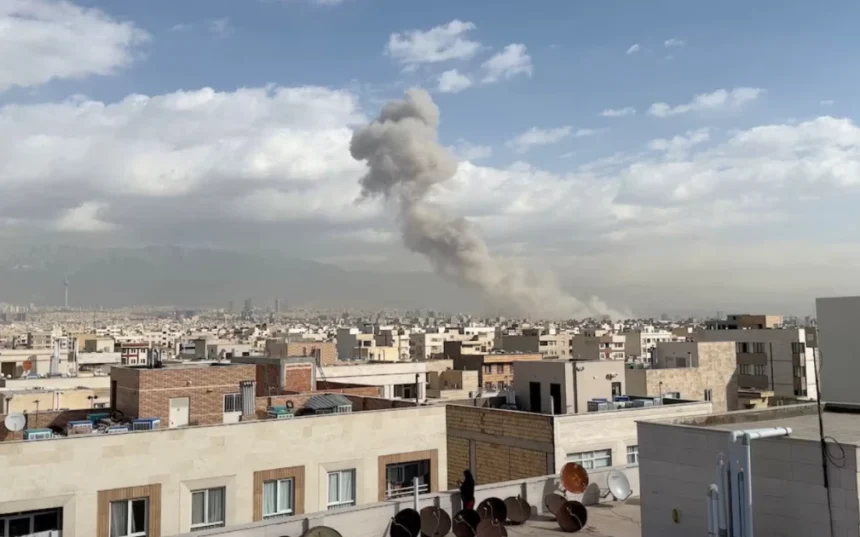
The long-dreaded “Red Line” has been crossed. In the early hours of Saturday, February 28, 2026, the night sky over Tehran was illuminated not by the moon, but by the fire of a massive, synchronized military campaign. Codenamed “Operation Roaring Lion” by Israel and “Operation Epic Fury” by the United States, the strikes mark the most significant military intervention in Iranian territory since the 1979 Revolution.
With explosions rocking at least seven major Iranian cities and President Donald Trump officially calling for the toppling of the clerical regime, the world is holding its breath as the “Great Reckoning” begins.
The Onset: “A Preemptive Strike”
At approximately 08:00 AM local time, Israeli Defense Minister Israel Katz announced that the Israel Defense Forces (IDF) had begun a “preemptive strike” to neutralize an “existential threat” to the state. Within minutes, U.S. officials confirmed that American air and sea assets were operating in tandem with Israeli jets.
The primary targets include:
Tehran: Missile strikes have been confirmed in the Jomhouri and University Street areas, specifically targeting districts housing the Presidential Palace and the National Security Council.
The Nuclear Corridor: Strategic hits have been reported at facilities in Qom, Isfahan, and Karaj, aimed at permanently dismantling Iran’s nuclear enrichment capabilities.
Missile Infrastructure: Launch sites and production centers in Tabriz, Kermanshah, and Ilam were targeted to “raze the missile industry to the ground,” according to U.S. statements.
The Trump Ultimatum: “Regime Change is the Goal”
Two hours into the operation, President Donald Trump released a defiant 8-minute video address on Truth Social. Standing before the American flag, he confirmed that the U.S. had begun “major combat operations” and framed the mission as a “once-in-a-generation” opportunity for the Iranian people.
“We are going to destroy their missiles and raze their industry to the ground,” Trump declared. “To the members of the IRGC: Lay down your arms and receive immunity, or face certain death. Our objective is to create the conditions for the brave Iranian people to take their destiny into their own hands.”
This shift from “targeted deterrence” to “open regime change” marks a radical departure in U.S. foreign policy, signaling that the administration is no longer interested in containment, but in a total political reset in Tehran.
Tehran’s Response: “A Crushing Retaliation”
The Iranian leadership has not remained silent. While reports initially suggested that Ayatollah Ali Khamenei had been moved to a “secure, underground bunker” outside the capital, state media quickly pivoted to war rhetoric.
The Retaliatory Wave: By 11:30 AM local time, the IRGC-affiliated Tasnim News Agency confirmed that a “new wave” of Iranian ballistic missiles had been launched toward Israel.
The Houthi Front: In a coordinated move, Iranian-backed Houthi rebels in Yemen have reportedly launched their own volley of drones and missiles toward the Red Sea and southern Israel.
Domestic Lockdown: The Iranian government has imposed a near-total internet blackout, with connectivity dropping to 54% across the country to suppress reporting on the extent of the damage.
Israel on Edge: The Underground War
Inside Israel, the atmosphere is one of grim determination. At 08:15 AM, air raid sirens echoed across the country, prompting citizens to move to fortified shelters.
State of Emergency: Defense Minister Katz has declared a 48-hour nationwide emergency.
Hospitals Underground: In a move not seen in decades, the Ministry of Health has ordered major hospitals, including Rambam in Haifa, to move their entire operations into reinforced underground parking lots.
Airspace Closed: Ben Gurion Airport has suspended all civilian flights as the Israeli Air Force (IAF) dominates the skies.
Economic Fallout: The Global Shockwave
The markets reacted with instantaneous panic.
Crypto: Bitcoin plummeted below $64,000 within an hour of the first reports.
Oil: With the Strait of Hormuz now a potential combat zone, oil prices are expected to surge toward $120/barrel as shipping companies reroute vessels around the Cape of Good Hope.
Travel: Global airlines have canceled all flights to the Middle East, leaving thousands of travelers stranded in transit hubs like Dubai and Doha.
The Verdict: Is This a “Multiple Day” War?
U.S. defense officials have signaled that this is “not a small strike” and is expected to last for multiple days. With two carrier strike groups, including the USS Gerald R. Ford, positioned in the region, the combined firepower of the U.S. and Israel is immense.