
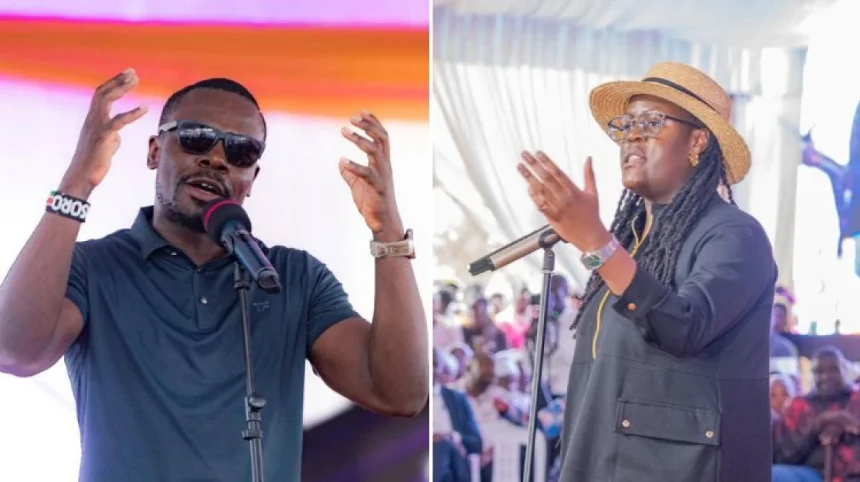
To the casual observer of Kenyan politics, the recent confrontation between East African Legislative Assembly (EALA) MP Winnie Odinga and National Assembly Majority Whip Sylvanus Osoro was just another Tuesday. In a political culture where funerals routinely double as open-air arenas for factional sparring, a shouting match at the podium barely moves the needle.
But beneath the flying dust, the heckling youth, and the tense security details lies a profound shift in the country’s political landscape. This clash wasn’t just an isolated dispute over regional grievances; it was a clear demonstration of the generational and ideological battle currently redefining the future of both the Orange Democratic Movement (ODM) and the ruling United Democratic Alliance (UDA).
Here is a strategic breakdown of what this high-stakes showdown really means for the country’s political trajectory.
1. Winnie Odinga: Stepping Up as the Grassroots Shield
For years, critics have viewed Winnie Odinga primarily through the lens of her family lineage. However, her aggressive response to Sylvanus Osoro’s polarizing remarks signals a deliberate evolution in her political identity. She is no longer just a strategist working behind the scenes; she is stepping onto the frontlines as an active defender of the opposition’s base.
By publicly taking on Osoro—one of Kenya Kwanza’s most vocal and unapologetic enforcers—Winnie is positioning herself as a protective shield for local communities against what the opposition terms “executive overreach.” Her speech did not rely on standard political insults. Instead, she anchored her argument in resource equity and constitutional rights, challenging the notion that state development should be used as a bargaining chip to extort political loyalty from taxpayers.
This approach resonates deeply with a younger, more politically conscious electorate that is increasingly cynical about traditional political patronage.
2. Sylvanus Osoro and the Politics of “Shock and Awe”
On the other side of the podium stands Sylvanus Osoro. The South Mugirango lawmaker has built a reputation as the ruling coalition’s “political battering ram.” From his infamous 2021 physical altercation with Governor Simba Arati to his recent bold pronouncements in Parliament, Osoro operates on a doctrine of political dominance.
His strategy at the funeral was clear: project the absolute power of the state. By hinting that opposition-leaning areas could face economic neglect if they continue to resist government policies, Osoro was testing the resilience of the local political infrastructure. It is a calculated “shock and awe” tactic designed to force local leaders into cooperation with the ruling party by making continuous opposition feel financially unsustainable.
However, as Winnie Odinga quickly pointed out, this aggressive style runs the risk of backfiring, turning local communities into a unified front against what they perceive as political bullying.
3. The Battle for the Soul of Nyanza and the South Rift
The geographic context of this clash is highly significant. The wider Nyanza region, including Kisii and Nyamira counties, has historically been a critical battleground. While parts of the region have voted overwhelmingly for ODM, it remains a fluid zone where the ruling coalition has made steady inroads through targeted development projects and strategic alliances with local leaders.
Supremacy Battlegrounds: Regional Influence Dynamics
┌───────────────────────────────┬───────────────────────────────┐
│ Opposition Strategy (ODM) │ Ruling Coalition Strategy │
│ │ (UDA) │
├───────────────────────────────┼───────────────────────────────┤
│ • Frame state resources as a │ • Leverage direct development │
│ constitutional right, not a │ funding to bypass local │
│ ruling party gift. │ opposition networks. │
│ • Mobilize youth through │ • Co-opt local leaders to │
│ anti-intimidation rhetoric. │ gradually erode opposition │
│ │ monopolies. │
└───────────────────────────────┴───────────────────────────────┘
When Osoro steps onto these platforms to issue warnings, he is executing a broader UDA strategy to dismantle ODM’s long-standing dominance. When Winnie Odinga pushes back, she is protecting the party’s historical stronghold. This creates a highly volatile dynamic where every public gathering becomes a high-stakes test of political strength.
4. Moving Past the “Handout” Doctrine
Perhaps the most significant takeaway from this confrontation is the changing vocabulary of the political debate. For decades, Kenyan politics has been heavily reliant on patronage—the idea that the ruling elite generously distributes public funds to loyal followers.
Winnie Odinga’s sharp rebuke of Osoro directly challenged this old paradigm. By reminding the Majority Whip that state funds are derived from the sweat of everyday taxpayers, she shifted the narrative from patronage to accountability. This is a critical distinction. It empowers the average citizen to view government infrastructure projects not as a favor to be begged for, but as a right that has already been paid for through taxation.
For a ruling coalition currently navigating complex economic policies and fiscal reforms, this emphasis on taxpayer rights is a potent and challenging argument for opposition leaders to wield.
Conclusion: The New Lines are Drawn
The funeral drama in the region was not an isolated event; it was a preview of the political landscape ahead. The confrontation between Winnie Odinga and Sylvanus Osoro underscores that the old rules of engagement are being rewritten by a new generation of leaders who are less inclined to compromise.
As both coalitions continue to define their strategies, the focus must shift away from intimidation and closer toward genuine engagement with the public. The politician who successfully captures the loyalty of the electorate will not be the one who threatens to withhold development, but the one who respects the intelligence and constitutional rights of the voter.