
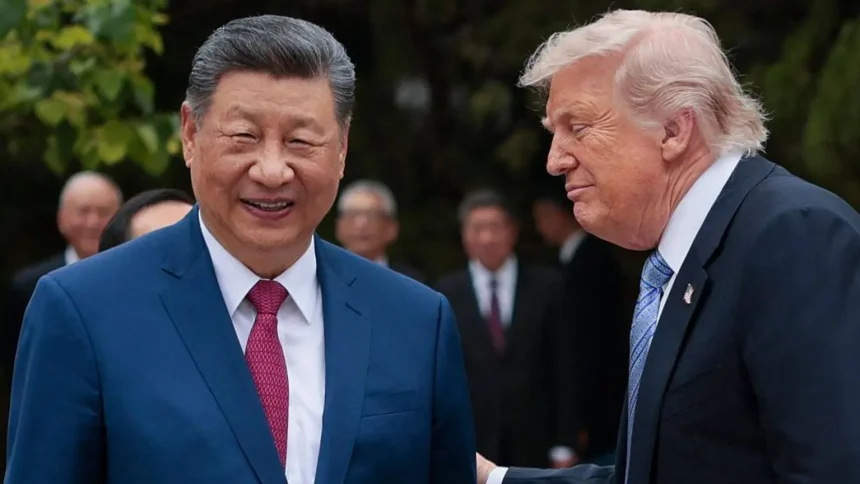
While the world’s cameras were fixed on the historic handshake between President Donald Trump and President Xi Jinping in the Great Hall of the People, a second, perhaps more consequential summit was taking place in the boardrooms of Beijing.
The “Business Brigade”—a delegation of America’s most powerful CEOs, including Tesla’s Elon Musk, Nvidia’s Jensen Huang, and Apple’s Tim Cook—did more than just provide a backdrop for the President. They were there to negotiate the terms of a new, pragmatic economic era. In a year defined by geopolitical tension, the message was clear: in the 2026 global economy, business interests may be the only bridge left standing between Washington and Beijing.
The Return of the Deal-Makers
President Trump’s decision to bring a massive CEO delegation to China marks a return to his “commercial diplomacy” roots. Unlike the ideological clashes of 2025, the May 2026 summit focused on Reciprocal Market Access.
For years, U.S. tech firms have faced a “glass ceiling” in China, while Chinese firms faced increasing bans in the U.S. In the private “Business Roundtable” sessions held on the second day of the summit, the conversation shifted. Sources indicate that the CEOs pushed for a “Sectoral Truce”—an agreement that would allow U.S. firms more autonomy in China’s burgeoning Artificial Intelligence (AI) and Electric Vehicle (EV) markets in exchange for stabilized supply chains for critical minerals.
Elon Musk and the “Giga-Diplomacy”
Elon Musk’s presence was particularly noteworthy. With Tesla’s Giga Shanghai factory remaining a cornerstone of the company’s global production, Musk acted as a “de facto” mediator. Reports from the summit suggest that Musk held private talks with Chinese Vice President Han Zheng regarding the integration of Full Self-Driving (FSD) technology in China.
This “Giga-Diplomacy” highlights a 2026 reality: multinational corporations are now sovereign actors in their own right. For Musk, the goal was simple—ensure that Tesla remains the dominant player in the world’s largest EV market, even as trade winds shift.
The Semiconductor Standoff: Jensen Huang’s Mission
Perhaps the most sensitive meetings involved Nvidia’s Jensen Huang. As the “AI Arms Race” heats up, the U.S. government’s export controls on high-end chips have been a major point of contention.
During the summit, Huang reportedly discussed the potential for “Special Export Licenses” for non-military AI applications. While the White House has officially maintained its “small yard, high fence” policy, the fact that Huang was at the table suggests that the 2026 administration is looking for a way to allow American companies to profit from China’s AI boom without compromising national security.
The “CEO Stroll” and the Optic of Success
On the final day, the image of Trump and Xi walking through a garden flanked by American and Chinese business leaders sent a powerful signal to global markets. This was “The Art of the Deal” on a civilizational scale.
While no formal government-to-government trade deals were signed, the “Business Brigade” reportedly left with:
Renewed Purchase Agreements: Billions in orders for U.S. agricultural products and Liquefied Natural Gas (LNG).
Joint Tech Standards: Preliminary talks on establishing international safety standards for AI.
Investment Protections: Assurances that U.S. physical assets in China would be protected from retaliatory seizures.
Why “No Official Deal” Suits the CEOs
To a CEO, a formal government treaty can often be rigid and slow to adapt. Many of the leaders in the delegation prefer a “Memorandum of Understanding” (MOU) style of engagement. By having the “Strategic Stability” framework established by the two Presidents, the CEOs now have the “top-cover” they need to sign private contracts without the fear of sudden political intervention.
This is a de-risking strategy at its finest. By keeping the official agreements vague, the 2026 administration avoids political backlash at home, while the private sector is given the “green light” to resume profitable operations.