

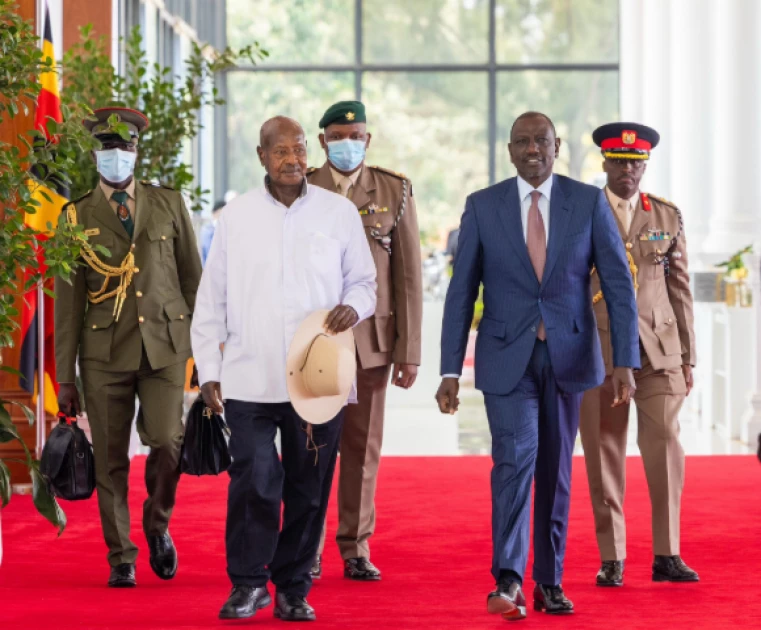
While our previous post covered President William Ruto’s formal congratulation to Uganda’s Yoweri Museveni on his re-election, the true story lies beneath the diplomatic surface. In the nuanced world of international relations, such messages are rarely just polite gestures. They are carefully crafted signals, laden with strategic intent. Ruto’s swift and public endorsement of Museveni is a masterclass in pragmatic statecraft. This analysis moves beyond the headline to decode the strategic message Nairobi is sending to Kampala—and the wider world. We will explore how this move secures Kenya’s economic interests, fortifies a crucial security partnership, and strategically positions both nations in the complex chessboard of East African politics.”
Body: The Deep Strategic Analysis (≈700 words)
H2: The Economic Calculus: Protecting Billions in Trade and Investment
Frame this as Kenya’s primary, non-negotiable interest.
Transit Trade Lifeline: Uganda is Kenya’s largest landlocked client for the port of Mombasa. A hostile or uncooperative Uganda could shift to Tanzania’s Dar es Salaam port, undermining Kenya’s massive infrastructure investments.
The SGR Dream: Kenya’s Standard Gauge Railway (SGR) is economically viable only if it reaches Kampala and beyond. Ruto’s support is an investment in Museveni’s cooperation to fast-track this critical project.
Stability for Business: Kenyan banks, telcos (Safaricom), and manufacturers have vast operations in Uganda. A stable political environment under a known partner (Museveni) is deemed preferable to uncertainty.
H2: The Security Imperative: A Unified Front in a Volatile Region
Highlight the existential security partnership.
The Al-Shabaab Factor: Both nations contribute heavily to the African Union Mission in Somalia (ATMIS). Seamless military and intelligence coordination is vital for regional security and domestic safety.
The Congo Equation: With instability in the Democratic Republic of Congo (DRC), a unified Kenya-Uganda position is crucial for mediating conflict and protecting their shared western flank.
Counter-Terrorism Cooperation: Cross-border operations and intelligence sharing require absolute political alignment at the top.
H2: The Diplomatic Signal: Crafting an “Axis of Influence” within the EAC
Analyze the power dynamics within the East African Community.
Consolidating a Bloc: Ruto and Museveni, as leaders of two of the “Big Three” (with Tanzania), can set the EAC agenda. This move sidelines potential friction and presents a united front.
Messaging to the West: The swift congratulation, despite Western concerns over the election’s democratic quality, is a signal of African solutions and sovereignty. It says, “We manage our affairs.”
Isolating Internal Dissent: It diplomatically reinforces Museveni’s legitimacy, making it harder for regional bodies to critique the electoral process.
H2: The Calculated Risks: What Kenya is Choosing to Overlook
This critical section builds analytical credibility by acknowledging trade-offs.
The Democracy Dilemma: By endorsing a contested election, Kenya potentially undermines its own democratic credentials and long-term advocacy for governance norms in the region.
Empowering a Competitor: A stable, confident Uganda under Museveni continues to develop its own infrastructure (e.g., oil pipeline with Tanzania) and could become a more assertive economic rival, not just a partner.
Public Perception: The move may be criticized by Kenya’s own opposition and civil society, who may see it as endorsing authoritarianism.
H2: The Road Ahead: Five Key Issues to Watch
Transition from analysis to prediction, giving readers a reason to return.
SGR Progress: Will Museveni fast-track the Kenyan SGR into Uganda?
Trade Barriers: Will non-tariff barriers on Kenyan goods (like milk and sugar) ease?
DRC Mediation: Will the Ruto-Museveni alliance play a decisive role in stabilizing Eastern Congo?
Succession Politics: How will Kenya engage with Uganda’s eventual post-Museveni transition?
EAC Expansion: How will this bloc influence the integration of new members like Somalia?
Conclusion & High-Value Call to Action (≈150 words)
Synthesize the analysis and position your blog as the go-to source for such insights.
“President Ruto’s congratulatory message was, in essence, a strategic down payment. It trades immediate diplomatic capital for long-term economic security and regional influence. The partnership is less about personal chemistry and more about cold, hard mutual necessity. The coming months will reveal if the investment pays off in tangible project deliveries and reduced trade friction. We will be watching closely. For ongoing analysis of these developments, bookmark our East Africa geopolitics section. We want to hear from you: Do you think Kenya’s strategic pragmatism outweighs the democratic principles at stake? Debate this in the comments. To get these insights delivered directly, join our exclusive ‘Africa Brief’ subscriber list for in-depth reports and expert interviews. Share this analysis with colleagues and networks interested in the future of East Africa.”