

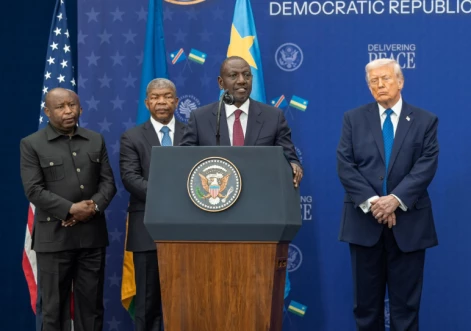
The Signing of a Generation
For decades, the conflict in Eastern Democratic Republic of the Congo (DRC) has been one of the world’s most persistent and devastating humanitarian crises—a seemingly intractable war fueled by ethnic tensions, political ambition, and the scramble for vast mineral wealth. It has claimed millions of lives, displaced countless more, and destabilized the heart of Africa. On December 4, 2025, in a ceremony at the White House, a new chapter was written. Rwandan President Paul Kagame and DRC President Félix Tshisekedi signed the Washington Accord, a landmark peace agreement brokered by the United States.
Present as a key regional witness and architect of earlier peace efforts was Kenyan President William Ruto. In a speech that blended solemn reflection with cautious optimism, President Ruto hailed the accord as a “historic” breakthrough and a “credible and hopeful pathway” to a future free from the horrors of war. He spoke of a conflict that had “endured far beyond what humanity can reasonably bear,” stealing the innocence of a generation. His presence underscored the vital, often understated, role of African-led diplomacy, while his words offered a powerful endorsement of the deal’s potential to reshape the region.
A Dual-Pronged Deal: Ceasefire and Commerce
The Washington Accord, also called the Washington Accords for Peace and Prosperity, is notable for its two-pronged approach. It seeks not only to silence the guns but to build a future where peace is underpinned by shared economic interest.
Key Pillars of the Washington Accord Details
Security & Peace Commitments – A permanent ceasefire and mutual respect for sovereignty and borders.
– Rwanda’s commitment to withdraw any troops and end support for the M23 rebel group.
– The DRC’s commitment to disarm and demobilize the FDLR militia.
– Establishment of a Joint Security Coordination Mechanism.
Economic Integration Framework – A new framework for U.S.-Africa partnership focused on the Great Lakes region.
– Bilateral agreements granting U.S. companies access to the DRC’s and Rwanda’s supplies of critical minerals (cobalt, lithium, rare earths).
– Focus on building joint infrastructure, supply chains, and shared prosperity to make peace economically sustainable.
This structure reflects a modern understanding of conflict resolution: lasting peace requires more than just a truce; it requires jobs, trade, and a tangible stake in stability for all parties.
Ruto’s Role: Bridging African Diplomacy and American Power
President Ruto’s speech masterfully wove together several critical narratives. First, he paid tribute to the years of African-led peace processes that laid the groundwork, specifically naming the Nairobi and Luanda processes led by former Kenyan President Uhuru Kenyatta and Angolan leaders. He positioned the Washington signing not as a brand-new initiative, but as the successful culmination of this persistent regional diplomacy.
Second, and most notably for the international audience, Ruto offered effusive praise for U.S. President Donald Trump. He extended “sincere gratitude” for Trump’s “steadfast commitment and decisive leadership” in hosting the final, decisive talks. This recognition served multiple purposes: it validated Trump’s foreign policy engagement, strengthened the U.S.-Kenya partnership, and added significant political weight to the accord by tying it directly to the American presidency.
The Shadow on the Sun: Cautious Realism Amid Celebration
Yet, the ceremony was not without its sobering moments—reminders that signatures on paper are just the beginning. Tellingly, Presidents Kagame and Tshisekedi did not shake hands during the event, a silent testament to the deep-seated mistrust that decades of war have bred. Reports from the ground indicated that clashes continued in Eastern DRC even on the day of the signing, highlighting the immense challenge of translating a document into peace on the ground.
Analysts were quick to label the “Trump-brokered peace as precarious.” Rwandan President Kagame himself tempered expectations, frankly stating, “There will be ups and downs.” The path ahead is fraught with the difficult tasks of disarming militant groups, reintegrating combatants, and managing local grievances that have festered for generations.
A Plea for the Future: From Congo to Sudan
President Ruto concluded his remarks with a forward-looking plea. He called on all parties to honor their commitments so that the millions displaced could finally return home and rebuild their lives. He then seized the diplomatic moment to make a broader appeal, urging President Trump to leverage this successful mediation to address the worsening humanitarian catastrophe in Sudan.
In doing so, Ruto framed the Washington Accord not as an end, but as a potential blueprint—a demonstration that with decisive leadership and a blend of security and economic strategy, even the world’s most stubborn conflicts could be nudged toward resolution.
Conclusion: A Milestone, Not a Finish Line
The Washington Accord stands as a major diplomatic milestone. For President Ruto, it was an opportunity to position Kenya as an indispensable regional stabilizer and to cement a strategic partnership with the United States. For the people of Rwanda and the DRC, it offers a fragile but undeniable hope—a document that holds the promise of a future different from the painful past.
As President Ruto so aptly noted, the true measure of this “historic” deal will not be the accolades in Washington, but the peace and prosperity it ultimately delivers to the villages and cities of the Great Lakes region. The signing was a momentous step, but the long walk toward lasting peace has only just begun.