

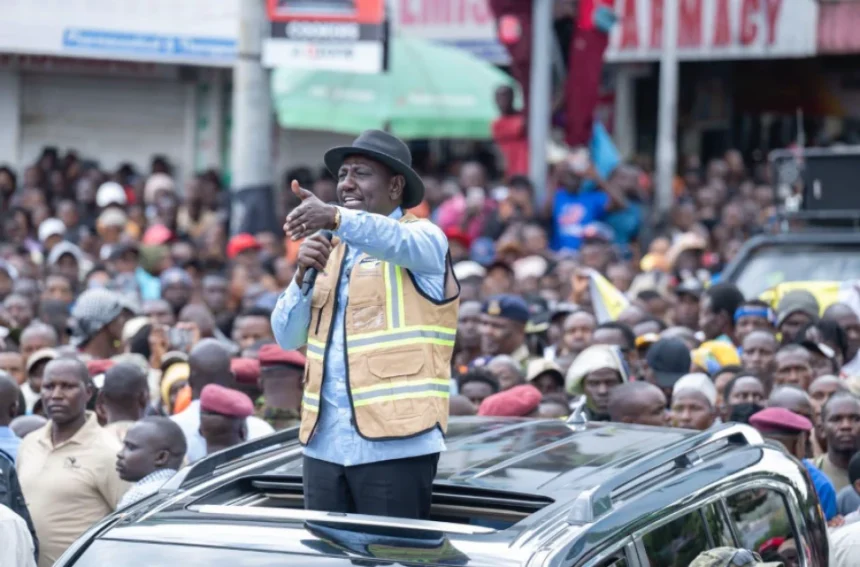
A Promise Echoing Through Time
For Kenyans who commute along the crucial Nairobi-Thika Highway, a recent announcement by President William Ruto must have felt like a peculiar case of déjà vu. In a public address, the President declared his administration’s commitment to dualing the Nairobi-Thika Road, framing it as a vital infrastructure upgrade to ease congestion and boost the economy. The statement, however, was met not with cheers, but with a collective national head-scratch and a flood of memes and puzzled questions online: “Wait, didn’t we already do that?”
The reason for the confusion is simple yet significant. The Nairobi-Thika Superhighway, an expansive 50-kilometre, 8-to-12-lane marvel, was one of Kenya’s most celebrated infrastructure projects of the last decade. Completed and inaugurated in 2012 at a cost of billions of shillings, it was already a dual carriageway—and then some. It transformed travel to Thika and the surrounding counties, becoming a symbol of modern Kenya. So, when the head of state promises to “dual” a road that is famously and functionally already a superhighway, it begs the question: what exactly is being promised, and why does the messaging feel so disconnected from a widely known reality?
Decoding the Pledge: Expansion, Upgrade, or Misdirection?
Analysts and citizens are left to decode what “dualing Thika Road” could plausibly mean in 2025. Several theories have emerged, each speaking to different public concerns:
The “Missing Link” or Extension Theory: The most plausible technical explanation is that the promise refers to dualing the remaining single-carriageway sections beyond the current superhighway’s endpoint. The Thika Superhighway officially ends near the Kenyatta University interchange. The road continues towards Thika town and beyond, with stretches that are still a congested, accident-prone single lane in each direction. The promise might be to finally extend the superhighway standard deeper into Kiambu County, a logical and needed upgrade.
The Major Rehabilitation Theory: After over a decade of heavy use, the superhighway is showing signs of wear and tear—potholes, damaged barriers, and drainage issues. “Dualling” could be a simplistic or misinformed shorthand for a comprehensive refurbishment and modernization of the existing road, perhaps adding smart traffic systems, better lighting, or non-motorized transport pathways.
The Political Communication Breakdown: The most cynical, yet widely held, view is that this represents a failure of targeted messaging. The promise may be intended for residents in areas beyond the superhighway who have long waited for an upgrade. However, by anchoring the promise with the well-known “Nairobi-Thika Road” brand, it sounds tone-deaf to the millions in Nairobi and its suburbs who use the already-dualled section daily. It inadvertently erases a major past achievement to pitch a future one.
A Symptom of a Bigger Trust Deficit
The public’s puzzlement transcends this one road. It taps into a deeper frustration with political communication and project continuity. Kenyans have seen grand infrastructure promises made, remade, and sometimes forgotten with changing political seasons. The Thika Superhighway itself is a powerful reminder of a completed promise, making its apparent “re-promise” jarring.
This episode raises critical questions:
Does the government’s own communications machinery have a firm grasp on what has already been built?
Are new announcements carefully crafted to acknowledge past achievements while outlining future progress?
Or does every new administration feel the need to “re-launch” or “re-claim” projects to create its own legacy, even at the cost of historical accuracy?
For the weary commuter, the request is simple: clarity. Is the plan to fix the potholes on the existing road, extend the superhighway to Thika town, or something else entirely? The confusion underscores a yearning for precise, factual communication that respects citizens’ intelligence and memory.
The Road Ahead: From Confusion to Clarity
President Ruto’s Thika Road pledge has accidentally opened a window into the public’s psyche. It reveals a populace that is observant, remembers infrastructure history, and is increasingly impatient with vague or recycled promises. The way the government clarifies this—through detailed engineering plans, accurate maps, and unambiguous language—will be just as important as the project itself.
The true test will be whether the next announcement about Thika Road brings a sigh of recognition (“Ah, they’re finally extending it!”) or another wave of bewildered memes. In the end, Kenyans aren’t just puzzled about a road; they are seeking assurance that their leaders are on the same page about where the country has been, to better navigate where it needs to go. The tarmac, it turns out, is the easy part. The mapping of trust is far more complex.
Recommendations for Your Blog
To make this blog post more engaging and effective, consider these additions:
Visual Impact:
Add a Map: Include a simple map showing the current Nairobi-Thika Superhighway (highlighted in one color) and the speculated extension or single-lane sections beyond it (highlighted in another). This would visually clarify the “missing link” theory for readers.
Use Social Proof: Embed a couple of the most clever or representative social media reactions (memes or tweets) that captured the public’s puzzlement. This immediately connects with the reader’s own likely experience.
Encourage Engagement:
Pose a Poll: At the end of the post, ask your readers a direct question: “What do you think ‘dualing Thika Road’ actually means? A) Extending it beyond the current end, B) Rehabilitating the existing road, or C) A communication mix-up?” This can drive comments and interaction.
Link to History: If you have an old article or can link to a reputable source about the original 2012 superhighway opening, add it under a “Further Reading” section. This provides context and reinforces your point about it being a known, finished project.